Trump Demands Arab Nations Sign Abraham Accords as Part of Iran Peace Deal
The US president ties normalisation with Israel directly to the outcome of Iran negotiations, even as fresh American strikes draw Iranian accusations of a ceasefire violation.
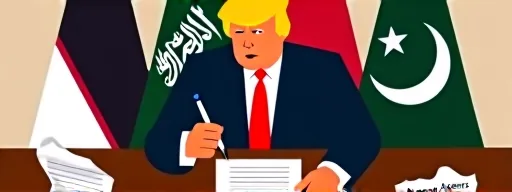
On Monday, while American warplanes were striking what the Pentagon described as Iranian missile sites and mine-laying boats in the southern province of Hormozgan, President Trump issued a sweeping demand from Washington: a clutch of Muslim-majority nations must simultaneously sign the Abraham Accords, normalising ties with Israel, as a mandatory component of any deal to end the seven-week-old conflict with Tehran. The juxtaposition — diplomatic ultimatum punctuated by fresh military action — laid bare the extraordinary breadth of Trump’s transactional vision for the Middle East.
In a 565-word post on his Truth Social platform, Trump said he had spoken on Saturday to the leaders of Saudi Arabia, Qatar, Pakistan, Turkey, Egypt, Jordan and Bahrain, and insisted that “at a minimum” they all sign the accords en masse. Bahrain and the United Arab Emirates had already done so under the 2020 framework; Morocco and Sudan followed. But the demand now extends to states with no formal ties to Israel, linking their participation to the outcome of painstaking Iran diplomacy. “Negotiations with the Islamic Republic of Iran are proceeding nicely!” Trump wrote, adding that failure would mean a return “to the Battlefront and shooting, but bigger and stronger than ever before.”
Viewed from Tehran, the sequencing could not have been more incendiary. Iran’s foreign ministry denounced the overnight US strikes — reportedly targeting missile launch sites and vessels — as a “gross violation” of the fragile ceasefire. This, even as Secretary of State Marco Rubio signalled that a negotiated end to the war could be just days away. European diplomats, already sceptical of a breakthrough, note that the strikes risk hardening Iran’s position, making any simultaneous signature ceremony with Israel a virtual impossibility.
Gulf analysts point to another obstacle: Saudi Arabia’s Crown Prince Mohammed bin Salman has repeatedly conditioned normalisation on a “clear path” to a two-state solution for the Palestinians. That demand, conveyed to Trump and reiterated in private briefings, remains unmet. Trump’s post made no mention of Palestinian statehood, instead framing the accords as the “most important Deal” in the region’s history and expressing his “honour” at the prospect of Iran eventually signing too.
For a president who has long touted the Abraham Accords as his signature diplomatic achievement, the gambit attempts to turn a conflagration into an opportunity for legacy-building. Yet by tying the Iran file so explicitly to Israeli regional integration, he has yoked two of the Middle East’s most volatile disputes into a single, high-stakes negotiation. Whether that complexity yields a grand bargain or simply collapses under its own weight will depend on whether Washington can convince Tehran, Riyadh, and Arab publics that the price of peace is not the abandonment of Palestinian aspirations.
This story appeared in
16 sources · 2 languages · 24h window