Protester Shot Dead as Anger Over US Ebola Facility in Kenya Escalates
A Kenyan demonstrator was killed by police gunfire in Nanyuki on Tuesday during renewed protests against a planned American quarantine centre, after two deaths last week and a court challenge deepened the crisis.
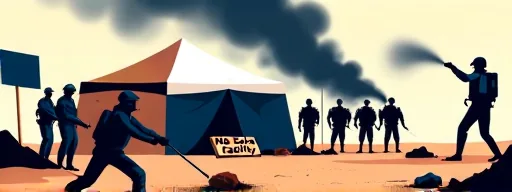
A protester was shot in the head and killed on Tuesday in the central Kenyan town of Nanyuki, where a second week of demonstrations against a proposed US-run Ebola isolation unit turned deadly. Witnesses saw the man’s body, bearing a bullet wound to the back of the skull, lying motionless in a police van as officers fired tear gas and water cannon to clear hundreds of demonstrators. At least nineteen people were arrested, according to the rights group Vocal Africa, which confirmed that police had opened fire. The violence came hours after crowds, some wearing protective equipment and carrying a coffin marked “Ebola”, had gathered near the Laikipia Air Base, the planned site of the facility.
The 50-bed quarantine centre is intended to receive American citizens arriving from the Ebola outbreak in the eastern Democratic Republic of the Congo and Uganda, a mission that Washington describes as a prudent public health measure. But Kenya has never recorded a case of the highly contagious haemorrhagic fever and shares no border with the affected zones, fuelling accusations that the US is simply offloading a health risk onto African soil. “We don’t have that disease in this country... they are bringing a virus into our country,” said Zipporah Wachira, 30, one of the protesters. The scheme has ignited nationwide anger, with many Kenyans pointing to the base’s proximity to schools, businesses and residential neighbourhoods.
The latest fatality follows the killing of two protesters during clashes on the previous Monday, bringing the death toll to three in under a fortnight. Tensions have been compounded by a formal legal challenge from the Laikipia County government, which argues that the central authorities failed to conduct adequate public consultations or meet constitutional and public health standards before green-lighting construction. County health executive Albert Taiti told the High Court that while the county supports national preparedness efforts, the project directly endangers local residents and institutions. Despite those proceedings, work at the site has continued, and both Nairobi and Washington have publicly reaffirmed their commitment to the plan.
Viewed from European capitals and Washington, the crisis highlights the perennial friction between global health security programmes and local consent. Analysts in London note that the rapid, court-defying push to build the facility risks entrenching suspicion of foreign military-backed initiatives in East Africa, where memories of past health emergencies have left communities wary of being used as experimental filters. With the legal battle still in its early stages and emotions running high, any further use of lethal force by security services could turn a local planning row into a deeper test of the US-Kenya strategic partnership.
How the same story is told elsewhere.
Kenyan protesters clashed with police, leaving one dead, over a US-run Ebola quarantine centre they fear will import the deadly virus into a country that has never recorded a case. Authorities stand accused of bypassing local consultations and ignoring public health concerns. The backlash has already triggered tourism cancellations and legal challenges.
European reports underscore the deadly clash at a US-run Ebola quarantine centre in Kenya, with a protester shot in the head. Outlets quote demonstrators telling Americans to ‘take their Ebola back’ and ridicule the idea of building such a facility in a tourist town. The coverage highlights the unbalanced US-Kenya relationship, suggesting Nairobi feels indebted due to years of aid.
Latin American media report the death of a protester during demonstrations against a US Ebola quarantine centre in Kenya, noting the facility is for American citizens exposed to the virus. The coverage stays largely descriptive, recording clashes, arrests, and the immediate violent turn. No strong editorial stance is taken, framing the event as a breaking-news security incident.
This story appeared in
17 sources · 7 languages · 24h window