Qatar Emir Presses for Diplomacy as Tehran Signals Readiness for ‘Honourable’ End to 88-Day War
As a devastating US-Iran conflict enters its 88th day, Qatar’s ruler urged de-escalation, while Iran’s president declared willingness for a dignified framework, provided Washington matches words with action.
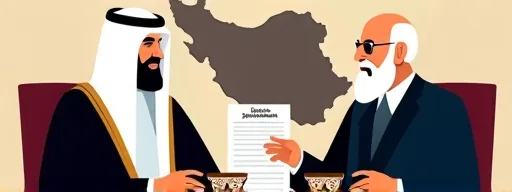
The telephone call on Tuesday between Qatar’s Emir Sheikh Tamim bin Hamad Al Thani and Iranian President Masoud Pezeshkian unfolded against the brutal arithmetic of an 88-day war that has claimed thousands of lives and triggered the most severe global energy shock in decades. In public readouts, Doha emphasised its unwavering commitment to political and diplomatic solutions, with the Emir insisting that all parties must exercise “the utmost responsibility and wisdom” to spare the region further escalation. The Qatari leadership, which has carved out a role as the principal interlocutor between Tehran and Washington, also expressed rare public appreciation for Iran’s engagement in dialogue and its constructive work to contain tensions.
Viewed from Tehran, the exchange carried a distinctly different emphasis. Iranian state-linked media highlighted Pezeshkian’s statement that the Islamic Republic is prepared to pursue an “honourable framework” to end the fighting and regional tensions. He stressed that Iran has demonstrated its sincerity and adherence to diplomacy and the spirit of agreements, but that the moment had come for the other side to translate its professed will into practical, demonstrable commitment. This carefully chosen language—coupling readiness for peace with an insistence on reciprocal, dignified terms—speaks to a domestic audience wary of appearing to capitulate under the pressure of a protracted war.
The contrasting framings illuminate a persistent asymmetry in how the two sides position the mediation. Gulf and Levantine Arabic outlets foregrounded Qatar’s call to privilege diplomatic channels and the Emir’s explicit urging of continued “positive engagement in negotiations.” Iranian sources, by contrast, led with Pezeshkian’s Eid al-Adha greetings before pivoting to the conditions under which Iran would de-escalate, framing the onus squarely on the adversary. Nowhere is this divergence sharper than in the phrase “honourable framework,” which appears exclusively in Iranian coverage and functions as a signal that any settlement must preserve national prestige and avoid unilateral concessions.
Analysts in London note that Doha’s balancing act is becoming more precarious as the war grinds on. Qatar is simultaneously hosting diplomatic backchannels, coordinating energy market stabilisation talks, and managing its own security exposure in the Gulf. The Emir’s public commendation of Iranian restraint—rare in previous mediation rounds—suggests a calculated effort to keep Tehran tethered to the negotiating track at a moment when hardliners could still scupper a deal. For its part, Washington has not publicly commented on the call, but the White House’s own backchannel communications have long relied on Doha’s ability to extract credible commitments from the Iranian leadership.
Whether this diplomatic choreography can translate into a durable ceasefire rests on bridging the gap between Tehran’s demand for a “dignified” outcome and the maximalist positions that triggered the February offensive. The war has reshaped energy markets and military postures across the Middle East, but it has also created a rare alignment of pain: all parties are now feeling the economic and human costs deeply. That, as much as any telephone diplomacy, may yet drive a framework forward—provided the language of honour can be squared with the realities on the battlefield.
This story appeared in
5 sources · 2 languages · 24h window