Trump Says He Would Be ‘Honoured’ to Meet Iran’s New Supreme Leader
The US president signalled willingness to hold direct talks with Ayatollah Mojtaba Khamenei if a peace deal is struck, marking a potential diplomatic shift.
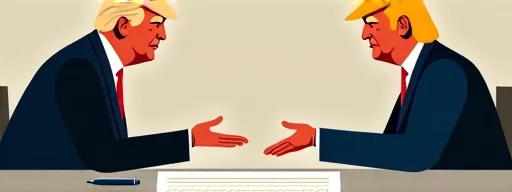
President Donald Trump said on Thursday he would be “honoured” to meet Iran’s new Supreme Leader, Ayatollah Mojtaba Khamenei, if the two nations can reach a peace agreement. Speaking to reporters in the Oval Office, Trump added that while he did not particularly want such a meeting, he would not object if a deal were in place. “I’d be honored to meet him,” he said. “If we make a deal, it’s possible that I would meet … I’d be okay with that.” The remarks came weeks after Mojtaba Khamenei, a senior cleric, was elected by Iran’s Assembly of Experts to succeed his father, Ayatollah Ali Khamenei, who was killed in a February strike on his Tehran residence that Iran blames on the United States and Israel.
Trump, who has maintained a hardline posture towards Tehran, acknowledged that he was likely not Khamenei’s “favourite person”. Yet he described the new leader as a professional and noted that in some circles, Khamenei “actually has a very good reputation”. The US president tempered expectations, however, telling reporters he had “not heard much” about the possibility of a summit and could not say whether one was likely.
Viewed from Washington, the overture represents a notable rhetorical softening. For years, the Trump administration has led a “maximum pressure” campaign against Iran, and the president himself authorised the 2020 strike that killed Quds Force commander Qasem Soleimani. By dangling the prospect of a personal meeting, Trump is signalling a potential diplomatic off-ramp — albeit one strictly conditional on a broader settlement that would end hostilities. Analysts in London note that such a shift, while tentative, echoes Trump’s willingness to engage directly with long-time adversaries such as North Korea.
In Tehran, the reaction is likely to be wary. The official narrative, embodied in the state-linked Mehr news agency, describes the elder Khamenei’s death as a “martyrdom” in a “cowardly US-Israeli strike”, underscoring the deep mistrust. The new leader, Mojtaba Khamenei, has long operated in the shadows of Iranian power and is seen as a hardline conservative. Any outreach from Washington will be scrutinised for sincerity, and Iranian officials have repeatedly said that meaningful talks can only occur if all sanctions are first lifted.
For now, the path to a meeting remains unclear. Trump’s comments may serve as a trial balloon to gauge the new Iranian leadership’s appetite for engagement. Yet without concrete steps — a ceasefire, a credible negotiating track — the offer risks being dismissed as political theatre. As the region braces for the next US-Iranian inflection point, the guarded optimism of a potential handshake masks the deep chasms that still divide the two capitals.
How the same story is told elsewhere.
Trump says he would be honoured to meet Iran’s new Leader, who was elected after his father’s martyrdom in a cowardly US-Israeli strike. The Islamic Republic frames the gesture as grudging respect for its steadfastness and embeds the moment in a long narrative of resistance to Western aggression.
Despite Trump’s willingness to meet, negotiations with Tehran remain deadlocked and the fragile Israel-Lebanon truce, seen as key to facilitating talks, has already collapsed. The deteriorating regional backdrop feeds deep scepticism about whether a deal can actually be struck.
Trump says he is ready to meet Ayatollah Khamenei on condition a deal is struck, and negotiations are going well – an agreement might be reached as soon as this weekend. The coverage stays calm and detached, simply noting the US president’s pragmatic overture.
This story appeared in
7 sources · 6 languages · 24h window