Trump Orders Early AI Review for Security, Balancing Innovation and Safety
US President signs executive order granting government up to 30 days early access to advanced AI models for cybersecurity vetting, after earlier delay over innovation fears.
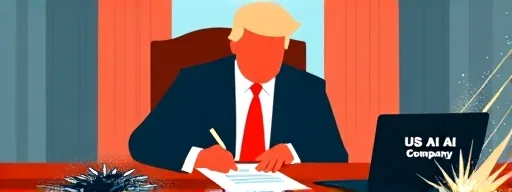
President Donald Trump signed a closely watched executive order on Tuesday (June 2) establishing a framework for the United States government to assess the national security risks of the most advanced artificial intelligence systems before their public release. The directive, signed privately after a public ceremony was postponed, asks companies like OpenAI, Google and Anthropic to voluntarily submit models for testing up to 30 days ahead of launch. It also creates an AI cybersecurity clearinghouse and directs agencies to develop classified benchmarks to measure cyber capabilities, explicitly barring any mandatory licensing or pre-clearance regime.
The signing marked the culmination of weeks of internal White House debate and a reversal from the administration’s earlier laissez-faire posture. Trump had abruptly cancelled a planned ceremony in late May, warning he did not want to “get in the way” of American technological dominance over China. The decisive trigger, however, was the alarm caused by Anthropic’s Mythos model, which demonstrated an unprecedented ability to identify and exploit vulnerabilities in computer systems — including those of banks, governments and hospitals. The 30-day access window itself reflects a hard-fought compromise: an original draft reportedly proposed up to 90 days, while industry leaders pressed for just 14.
International coverage highlighted the tension between security imperatives and competitive pressures. European outlets, from Le Temps in Switzerland to Il Sole 24 Ore in Italy, described the measure as a “soft” and “prudent” step that reinstates a degree of federal oversight without imposing strict regulation. Latin American and Middle Eastern media noted the order’s voluntary nature and its explicit prohibition on mandatory licensing, framing it as a calibrated intervention designed not to stifle Silicon Valley’s edge. Asian perspectives, including from the South China Morning Post, underscored that the framework stops short of mandates precisely to avoid handing an advantage to China in the global AI race, a concern Trump himself repeatedly voiced.
Viewed from London or Brussels, the order represents an incremental but significant shift in US policy: a recognition that frontier AI systems pose security risks that even the most market-friendly administration cannot ignore. Yet its effectiveness remains uncertain. Critics argue that a voluntary arrangement relying on corporate goodwill may not adequately address the threat of malicious use, particularly by non-cooperative actors. The order’s architects hope it will build trust and set a precedent, but the real test will be whether the industry’s most consequential models are routinely shared with government reviewers — and whether the benchmarks and clearinghouse prove robust enough to catch emergent dangers. For now, the world’s leading AI developers have been put on notice that even in Washington, the era of total self-governance is drawing to a close.
How the same story is told elsewhere.
Trump's AI executive order is portrayed as a late and loosely-woven compromise, forced by the scare over the offensive capabilities of Anthropic's Mythos model. Signed without public ceremony, it relies on voluntary cooperation and shortens the review window from 90 to 30 days, satisfying neither proponents of strict rules nor the administration's libertarian wing.
Trump's executive order is dismissed as a lot of nothing, yet another flip-flop that does not genuinely regulate AI. While the president boasts of not stifling innovation in the race against China, the watered-down, voluntary measure is mocked for imposing no real obligations on big tech firms.
Trump's executive order signals a worrying interventionist turn: the government will now be able to test, and potentially veto, AI models before public release, overriding companies. The national security framing paves the way for full integration of AI into military and surveillance operations, accelerating a dangerous digital arms race.
Trump's order seeks security safeguards without slowing the race with China: a voluntary framework to vet the most advanced models up to 30 days before release, rejecting binding rules that would hurt US firms' competitiveness. A pragmatic move to address cyber vulnerabilities while preserving America's tech edge in the strategic rivalry between the two superpowers.
This story appeared in
34 sources · 5 languages · 24h window