Trump Deletes Jesus-Like Self-Image as Feud With Pope Leo XIV Deepens
US president claims AI depiction was of him as a doctor, not Christ, after attacking first American-born pontiff over Iran; JD Vance tells Vatican to stay out of policy.
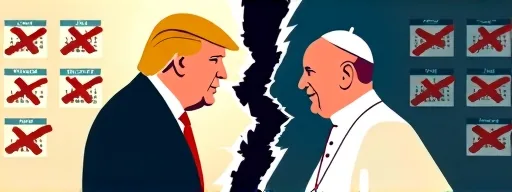
The most incendiary development in a rapidly escalating diplomatic and cultural confrontation came late on Sunday, when President Donald Trump posted an AI-generated image on Truth Social that appeared to depict him as a Christ-like healer, hovering over a sick man in a hospital bed. Hours earlier, he had unleashed a blistering attack on Pope Leo XIV, accusing the pontiff of being “weak on crime” and “terrible for foreign policy”. Within a day, the image was deleted, and Trump offered an explanation that left many of his own allies unsettled: “I thought it was me as a doctor, that it had to do with the Red Cross.”
The backdrop to this extraordinary episode is a quarrel over the intensifying US-Israeli military campaign in Iran. Pope Leo, the first American-born leader of the Roman Catholic Church, has been a sharp critic of the operation [A1][A8]. Trump’s Truth Social broadside went further, suggesting the pope owed his election to being American and that his criticism was “catering to the Radical Left” while effectively encouraging Iran to seek nuclear weapons. From Rome, the attacks landed as a deliberate provocation, tapping into deep sensitivities about the Vatican’s autonomy and the boundaries between faith and nationalist politics.
Viewed from Washington, the White House doubled down. Vice President JD Vance, a convert to Catholicism, appeared on Fox News to insist the Vatican should “stick to matters of morality” and leave American public policy to the president [A4][A5][A6][A9]. The remark, intended to shield Trump, instead highlighted the fracture inside his own coalition. Prominent religious conservatives and even some MAGA loyalists condemned the Jesus-like imagery as blasphemous, while American Catholics expressed dismay at the pitting of a sitting president against their spiritual leader [A7][A8]. The BBC reported ordinary faithful praying “they come together”, a sentiment reflecting anxiety over the unprecedented collision of faith and politics.
European Catholic circles in Paris and Rome reacted with a mixture of incredulity and alarm. French and Italian commentary noted that the image’s sacrilege was compounded by Trump’s flimsy retraction [A1][A9]. Analysts in London observed that this was the first time a US president had so publicly attacked a pope since the 19th century, and that Leo’s American identity — which Trump wielded as a claim of ownership — added a destabilising personal dimension. In Asia, where the spectacle was watched from a remove, the South China Morning Post framed the episode as an illustration of the capriciousness driving US foreign messaging [A2].
The long-term cost is already becoming clear. The administration, already navigating backlash over the Iran war, finds itself at odds with a global institution that commands the loyalty of millions of American voters [A5]. By deploying a crude AI persona and then retreating behind a literal reading, Trump has alienated not only liberal critics but a constituency his movement has painstakingly courted. Whether the Vatican chooses to respond formally or remains silent, the rift will colour US diplomacy in Europe and Latin America for months to come, and it has set a dangerous precedent for how leaders deploy artificial intelligence in political combat [A3][A8].
This story appeared in
14 sources · 3 languages · 24h window