Tinubu warns armed groups as Nigeria’s Democracy Day exposes security and economic fault lines
President claims 13,000 insurgents killed and urges youth to stay, but protests and opposition criticism underscore persistent insecurity and hardship.
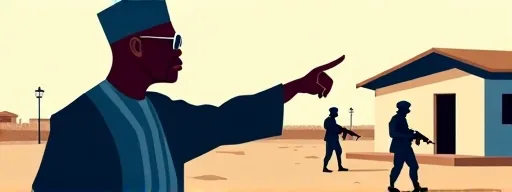
President Bola Tinubu used his Democracy Day address on Friday to issue an ultimatum to armed groups operating across Nigeria: “surrender or face the full force” of the state. The televised speech, marking 27 years of unbroken civilian rule, was dominated by security claims, including the assertion that over 13,000 “terrorists” had been killed in the past year and that terror-related deaths had fallen by 81 per cent since 2015 [A11][A21][A28]. Tinubu also disclosed that more than 124,000 fighters and their dependents had laid down arms since 2023 through a rehabilitation programme, framing the figures as evidence of a dual strategy of military pressure and reintegration [A24]. Yet the address was shadowed by the ongoing captivity of schoolchildren abducted in Oyo and Borno states, which the president acknowledged had “dampened” the national mood [A7][A25].
Beyond the battlefield statistics, Tinubu sought to defend his economic reforms, arguing that fiscal adjustments since 2023 had boosted federation revenues, improved transparency, and redirected resources to infrastructure, healthcare and security [A8][A18]. He pointed to a 21 per cent rise in non-oil exports and the certification of over 1,000 small businesses for export as signs of diversification [A41], while pledging to deliver reliable electricity as a “democratic dividend” [A42]. In a direct appeal to young Nigerians, he urged them not to “japa” – emigrate – but to “build here, code here, work here, and vote here” [A3][A37]. The speech also confirmed the conferral of national honours on 50 figures from the pro-democracy struggle, including journalists and retired military officers [A2][A20].
Viewed from Lagos, the address collided with street-level discontent. A coalition of civil society groups, trade unions and youth movements staged a protest under the Ikeja Bridge, demanding urgent action on insecurity and economic hardship [A9][A46]. Human rights lawyer Femi Falana used the rally to call for the immediate rescue of the abducted Oyo pupils and teachers, warning they were suffering severely in captivity [A22][A36]. Tensions flared when counter-protesters arrived, requiring police intervention to maintain order [A9]. In Oyo State, Governor Seyi Makinde disclosed that the 46 captives were still within the Old Oyo National Park corridor, underscoring the slow progress of rescue efforts [A47].
Opposition figures and analysts across the country were sharply critical. Former Vice-President Atiku Abubakar described the occasion as one for “sober reflection on the steady dismantling of democratic ideals” and called on Nigerians to reject bad governance [A12]. The African Democratic Congress dismissed Tinubu’s speech as “long on promises and short on answers” [A31], while ex-senator Dino Melaye said it was detached from reality and called for the president’s resignation [A33]. The Peoples Democratic Party declared that the lessons of the annulled 1993 election remained unlearnt and that democracy was still fragile [A48]. Former Senate President Bukola Saraki warned that weakening the legislature would endanger democratic stability [A38].
Diplomatic observers in Abuja noted that the British High Commissioner urged credible and inclusive elections in 2027, emphasising the role of civil society in sustaining democratic confidence [A43]. The National Human Rights Commission similarly demanded transparency from INEC and politicians ahead of the next general election [A15][A45]. Meanwhile, the passage of a constitutional bill to allow state police forces was hailed by Benue Governor Hyacinth Alia as a “bold step” towards localised security responses [A4][A35]. As Nigeria looks towards off-cycle governorship elections in Ekiti and Osun, Tinubu’s call for peaceful and credible polls [A26] will be tested against a backdrop of persistent abductions, economic strain, and a public increasingly willing to voice its frustration on the streets.
How the same story is told elsewhere.
Local press reports President Tinubu's Democracy Day address, highlighting his security claims, his appeal for youth to stay and build, and his acknowledgment of economic hardship. While some voices praise the rhetoric, others note that democratic dividends must be tangible. The narrative balances official optimism with cautious skepticism about implementation.
Western outlets focus on Nigeria's deepening security crisis and the president's unverified claim of 13,000 militants killed. They frame the mass emigration of young Nigerians as a vote of no confidence, and treat the speech as a mix of tough talk and pleas that may not address root causes. The tone is skeptical, with concern about regional stability and migration spillover.
Chinese media present the speech as a responsible leader's blueprint for national stability and development. They emphasize the government's counter-terrorism achievements, infrastructure projects linking producers to markets, and the call for youth to contribute at home. The framing is pragmatic, highlighting state-led solutions and long-term planning without delving into internal criticism.
Russian outlets portray President Tinubu as a decisive leader who has eliminated over 13,000 terrorists and is restoring order. They frame his warning to armed groups and his appeal to youth as signs of a sovereign state reasserting control. The narrative celebrates security successes and positions Nigeria as a partner resisting external destabilization.
This story appeared in
8 sources · 2 languages · 24h window