The Unseen Costs of Loss: Elephants, Mosquitoes, and a Fossil’s Warning
A Kenyan study proves megafauna decline triggers ecosystem collapse, while Google’s gene-edited mosquitoes and a museum fossil rewrite the rules of life’s fragility.
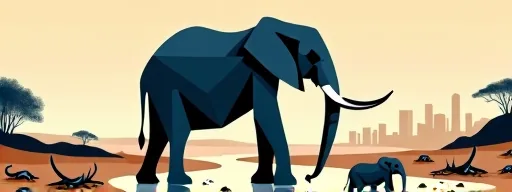
The disappearance of elephants from East African savannahs has been shown to trigger a hidden cascade of ecological collapse, according to a Princeton-led study that provides the first experimental proof of a long-suspected domino effect. Published in Science on 29 May, the research, conducted at Kenya’s Mpala Research Centre, exploited the long-running UHURU project—a natural experiment begun in 2008 that uses fencing to control access by large herbivores. In plots where elephants were excluded, dung beetle populations plummeted: numbers fell by 67 percent, total biomass dropped by 51 percent, and species richness declined by 23 percent. These insects, though unglamorous, are essential for nutrient cycling, soil aeration and seed dispersal, and their decline signals a broader unravelling.
Viewed from Nairobi or London, the findings underscore the asymmetrical damage wrought by the loss of keystone species—a warning as the planet’s large mammals face growing pressure. Yet even as such natural systems fray, human-engineered interventions are accelerating on an unprecedented scale. Google is seeking federal approval in the United States to release up to 32 million genetically modified mosquitoes across California and Florida over two years, in what would be the largest such programme in American history. The mosquitoes carry Wolbachia bacteria that disrupt reproduction, and aim to suppress wild populations of Culex species, vectors for West Nile virus and encephalitis. Previous pilots in California’s Central Valley and in Singapore—where a similar approach cut dengue cases by an estimated 70 percent in twelve months—have emboldened the company, which has already released more than a billion modified mosquitoes on four continents.
If the elephant study illuminates nature’s fragility from the top down, the mosquito project reveals an effort to manage it from the bottom up—each a reminder that removing or adding a single species can reconfigure entire ecosystems. The stakes of such understanding stretch deep into the past, as a fossil rediscovered at the Smithsonian Institution now makes clear. Archived since 1962, the Cambrian-era specimen has forced palaeontologists to reconsider a widely held theory that biodiversity suffered a severe crash over 500 million years ago. The find suggests that models of ancient mass extinctions may be incomplete, challenging the narrative of a late Cambrian collapse and implying that life’s resilience might be greater than previously assumed.
Analysts in Washington and Geneva note that these three threads—experimental ecology, high-tech biology, and palaeontology—converge on an urgent question: how to calibrate human intervention in a biosphere under strain. The Kenyan research demonstrates that losing a single thread can unravel the fabric, while Google’s gambit shows that deliberately tugging on another thread is possible but fraught with unknowns. The fossil, meanwhile, offers a humbling corrective, suggesting that past extinctions were more nuanced than our models capture.
Together, these developments sharpen a dilemma for policymakers and scientists alike. As biodiversity declines accelerate, technological fixes gain allure, yet the full ecological consequences of either inaction or intervention remain opaque. The coming years will test whether lessons drawn from elephants, mosquitoes and ancient fossils can guide a wiser stewardship—or whether each new intervention merely adds to an accumulating ledger of unintended consequences.
How the same story is told elsewhere.
Google is expanding its mosquito control program, planning to release up to 32 million sterile male mosquitoes in California and Florida. The males do not bite, and the approach has shown promise in reducing disease transmission.
The plan to release 32 million genetically engineered mosquitoes has sparked both hope and alarm. Scientists say the bacteria-infected insects will crash wild populations, but critics worry about unforeseen consequences.
This story appeared in
5 sources · 4 languages · 24h window