Clashes Erupt as Bolivia Security Forces Move to End Road Blockades
A pre-dawn operation to clear a strategic highway in Santa Cruz triggered violent confrontations, leaving at least 20 injured and highlighting the deepening crisis over protests demanding President Rodrigo Paz's resignation.
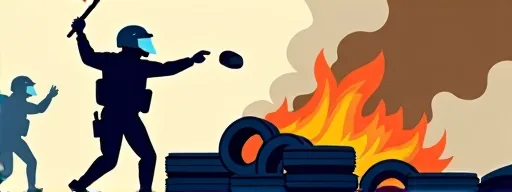
Bolivian security forces launched a pre-dawn operation on Saturday to clear a strategic highway in the eastern department of Santa Cruz, triggering violent clashes with protesters that underscored the deepening political crisis facing President Rodrigo Paz. Police and military units used tear gas to disperse demonstrators who had for more than three weeks blocked the road at San Julián with barricades of tyres and debris. Protesters responded by hurling stones and, according to official accounts, opening fire on officers, leaving several seriously injured.
The standoff in San Julián is just one front in a nationwide wave of road blockades—numbering around 100—that has paralysed supply chains and stoked anger over fuel shortages and rising prices. The protesters, a loose coalition of grassroots groups, insist that Paz, a centre-right businessman elected last October, step down immediately. They accuse his government of economic mismanagement and authoritarian drift, though the president retains support in the urban business class and the military high command.
Reporting on the casualties varied by geographical vantage point, reflecting the polarised nature of the conflict. Argentine and Brazilian media, drawing on local police sources, highlighted the toll on law enforcement: at least six officers wounded, four by gunfire, with one in intensive care due to a head injury. A Swedish wire service noted that two police were evacuated with bullet wounds. Brazilian outlets further reported that more than 20 people were injured overall, suggesting a broader human cost rarely captured in official tallies. No independent verification of the total number of wounded civilians was immediately available.
For Paz, the confrontation represents the most serious test of his presidency since the disputed 2024 election that brought him to power. While he has dismissed the protesters as violent extremists, the persistence and geographic spread of the blockades point to deep-seated grievances that transcend a simple law-and-order narrative. Analysts in Latin American capitals warn that the government’s reliance on military force risks inflaming tensions further, especially in regions that have been historically suspicious of central state authority.
As the dry winter season begins, reducing the logistical hurdles for security operations, further clearances are likely. Yet each confrontation risks eroding Paz’s already fragile legitimacy and deepening political polarisation. Whether the president can regain the initiative through dialogue—or whether the streets will continue to dictate Bolivia’s political trajectory—remains an open question.
How the same story is told elsewhere.
The Nordic press portrays the clashes with detachment, noting that protesters systematically blocked roads across Bolivia and police, backed by military vehicles, used tear gas to clear a blockade in San Julián. During the confrontation demonstrators threw stones and burned tires, and two officers were taken to hospital. The reporting relies on agency sources and avoids editorial commentary.
The Latin American market-oriented press frames the events as an escalation of a month-long crisis, highlighting the violence and the government under siege. It reports that a road-clearing operation in San Julián left six police officers wounded, one seriously, and at least 20 injured overall, including four officers shot. The coverage underscores the disruption and the roadblocks that are causing shortages of food, medicine, and fuel in cities, while the government struggles to contain the unrest.
This story appeared in
6 sources · 3 languages · 24h window