Sechin warns $250 oil possible as Hormuz crisis reshapes markets
Rosneft CEO pledges stable Russian supplies to Asia but cautions that tighter sanctions could compound the Strait of Hormuz blockade, benefiting US firms.
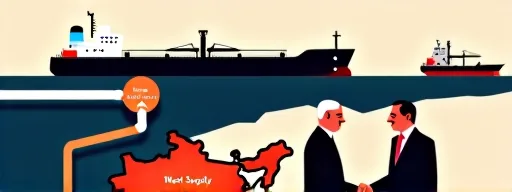
Igor Sechin, chief executive of Russian state oil giant Rosneft, delivered a double-edged message at the St Petersburg International Economic Forum on Saturday: promising reliable crude flows to Asia while warning that escalating sanctions could drive prices beyond $250 a barrel. Addressing delegates, Sechin described India as a strategic partner and one of the key engines of global energy demand growth, insisting that Russia would remain a dependable supplier despite the turmoil in West Asia.
The remarks come against the backdrop of the most severe supply shock in decades. In February 2026, Iran blockaded the Strait of Hormuz — the conduit for roughly a fifth of the world’s seaborne oil — after US and Israeli strikes killed Supreme Leader Ayatollah Ali Khamenei. Yet crude prices have not soared as many feared; instead, a combination of record US exports, a sharp and unexpected slowdown in Chinese demand, and a modest but persistent flow of oil still navigating the choke point has kept Brent below $100. Analysts in London note that these stopgaps have averted the $200-a-barrel scenario long forecast by industry doomsayers.
Sechin, however, accused Washington of orchestrating the crisis to advantage its own energy firms. “The closure of the Strait of Hormuz is an attempt to reshape global energy market regulations to benefit the United States,” he said, according to Moscow’s account of the closed-door session. Viewed from New Delhi or Beijing, such claims resonate: the blockade has forced Asian buyers to navigate a fragmented market, while US exporters have stepped into the breach, selling cargoes at a premium.
The Rosneft chief’s worst-case scenario marries the Hormuz blockade with intensified restrictions on Russian crude. Such a pincer movement on supply, he warned, would ignite a price spike far in excess of the current equilibrium. With Western capitals still weighing further sanctions on Moscow over the protracted war in Ukraine, the oil market’s fragile balance could be upended rapidly.
For now, the global energy system is absorbing a historic disruption with unorthodox fixes. But the broader realignment — with Russian supply lines pivoting decisively eastward, US production filling gaps in Europe and Asia, and Middle East transit routes contested — signals a prolonged period of volatility. As one Gulf-based trader put it, the only certainty is that the old certainties no longer hold.
How the same story is told elsewhere.
Rosneft guarantees stable Russian oil deliveries to India, calling it a strategic partner despite the war in West Asia and global supply chain disruptions. China, too, will continue to receive regular supplies, according to CEO Igor Sechin at the St. Petersburg forum.
The Rosneft chief says US energy companies are the main beneficiaries of the Strait of Hormuz closure, which he describes as an attempt to redraw global energy markets in Washington's favour. The blockade followed US-Israeli strikes on Iran and has disrupted a fifth of world oil shipments.
A slew of workarounds has kept crude oil below $100 a barrel, defying forecasts of a spike above $200 after the biggest supply shock in modern history. Despite the effective closure of the Strait of Hormuz for more than three months, the doomsday scenario has been avoided.
Oil could surpass $250 a barrel if sanctions on Russian crude deepen while the Strait of Hormuz remains closed, warns the CEO of Rosneft. US energy firms are meanwhile said to benefit from the crisis, though some ask why prices have not yet reached $200, pointing to alternative routes. The Latin American bloc highlights both extreme risk and the paradox of still-contained markets.
This story appeared in
7 sources · 3 languages · 24h window