World Cup 2026: An $11bn Prototype, Hubris, and a Latin American Boon
As North America prepares for the first 48-team tournament, financial projections clash with expert doubts, host cities struggle with costs, and outlying economies from Mexico City to Bogotá bank on a consumer boom.
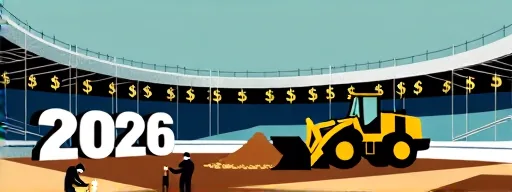
The 2026 FIFA World Cup, to be jointly staged by the United States, Canada, and Mexico, is being billed not merely as a sporting jamboree but as the largest commercial and technological mobilisation in the history of sport. With the field expanded to 48 teams and 104 matches, tournament revenues are projected to exceed $10.9 billion (€10.1 billion), nearly double the haul from Qatar in 2022. Organisers and allied industries are framing the event as a prototype for the digital and infrastructure economies of the future, fusing artificial intelligence, smart venues, and sustainability at a scale never before attempted.\n\nYet a growing chorus of economists warns that the financial windfall, particularly for the United States, may be far more modest than these grand visions imply. A joint study by FIFA and the World Trade Organization had forecast a global gross economic impact of $80 billion, with $30.5 billion accruing to the US. But Victor Matheson, a sports economist at the College of the Holy Cross, told Newsweek that the true impact is “likely to be a fraction of what is being advertised”. With thousands of tickets still unsold barely a fortnight before kick-off, and mounting hosting costs, the calculus looks increasingly uncertain. Across the border, Mexico’s authorities are notably more sanguine. A study by The Competitive Intelligence Unit estimates that the tournament will inject $2.57 billion directly into the Mexican economy, driven by tourism and temporary employment, even as officials scramble to manage urban mobility and security.\n\nThe geographic ripples extend well beyond the host nations. In Bogotá, far from any matchday pitch, city officials project that the World Cup will add 1.6 trillion Colombian pesos (approximately €340 million) to the capital’s GDP in the second and third quarters of 2026. The surge is expected to flow not through stadium turnstiles but through household consumption: sales of televisions, sound equipment, food, and drink are forecast to jump by 377 billion pesos as residents gather to watch the national team. This pattern underscores how the tournament’s economic logic has evolved into a globally dispersed, consumer-led phenomenon, detached from physical presence at the venues.\n\nIn a distinct but telling policy move, the United States Treasury and Mint have launched a commemorative coin programme whose surcharges will be channelled entirely to youth football initiatives for children of American military personnel. Announced in late May, the initiative—framed by Treasury Secretary Scott Bessent as a reflection of President Trump’s “unwavering commitment” to the armed forces—mints gold, silver, and clad coins that are already sparking collector interest. While modest in fiscal terms, it is emblematic of how governments are leveraging the World Cup brand to advance ancillary agendas, from military family welfare to financial numismatics.\n\nLooking ahead, the 2026 tournament will likely be remembered less for any single revenue headline than for the fault lines it exposes. Viewed from Washington, the mismatch between exuberant projections and ground-level caution highlights the dangers of mega-event boosterism. For Mexico City and Bogotá, the exercise is a calculated bet on consumer sentiment. And for FIFA, the tournament is a live laboratory for embedding advanced technologies into the fan experience—from AI-driven logistics to cashless stadiums—that may define the future of global sport. The real legacy, in this reading, will be measured not in dollars but in the resilience of the prototype.
How the same story is told elsewhere.
The 2026 World Cup is framed as an $11 billion transformation experiment, set to reshape global trade, infrastructure, and capital markets. More than a sports spectacle, it is a prototype for the digital and urban economies of the future.
The 2026 tournament is seen as a powerful economic engine for Latin America: Mexico would reap $2.57 billion and Bogotá a 1.6 trillion peso boost driven by consumption and retail. Even ancillary initiatives like the U.S. commemorative coins reinforce the narrative of tangible benefits for communities.
Experts downplay expectations: the actual impact on the U.S. economy would be far more modest than forecast, with high hosting costs and thousands of unsold tickets just two weeks before kickoff. The financial windfall is likely a fraction of the advertised figures.
This story appeared in
8 sources · 3 languages · 24h window