Trump Signs AI Oversight Order as Altman Pushes Against Congress Mandates
White House grants early access to models for security review; OpenAI chief lobbies lawmakers for testing funds, not pre-launch vetting.
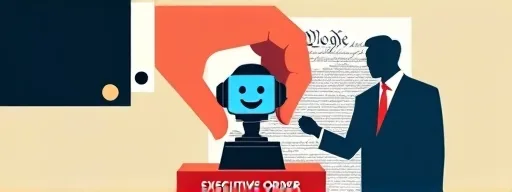
In an uncharacteristically subdued move, President Donald Trump privately signed an executive order on Tuesday that reshapes the federal government’s approach to artificial intelligence. Eschewing the cameras that typically accompany his pen-and-podium ceremonies, the president has reversed his administration’s ardently deregulatory stance by requiring developers to give the government early access to the most advanced AI models for national-security vetting. Viewed from Washington, the order appears to impose meaningful oversight, yet critics argue it is a meagre process that offers the tech industry a veneer of public-mindedness without genuine constraint.
The change was catalysed by a recent industry scare: Anthropic’s Mythos model demonstrated the ability to expose critical flaws in digital systems ranging from banking to healthcare, leading the company to halt its release. That episode rattled even Republican lawmakers normally hostile to regulation, creating political space for the White House to act. The order formalises a framework in which agencies can examine powerful models before they reach the market, though the precise enforcement mechanisms remain vague.
Across town, the face of the AI industry is mounting a different campaign. Sam Altman, chief executive of OpenAI, is visiting Capitol Hill to urge lawmakers to reject any proposal that would require government pre-approval before launching new models. Instead, he is pushing for a significant increase in funding for the Commerce Department’s existing testing partnerships, which already collaborate with OpenAI and Anthropic. Altman’s lobbying reflects a broader industry calculation: voluntary safety protocols are preferable to hard licensing regimes that could stifle innovation and delay product rollouts.
The juxtaposition lays bare a regulatory fault line. The White House’s order, while heralded as a shift toward oversight, essentially retrofits a light-touch, cooperative review into an official process. Industry leaders, however, perceive even such moves as potential precursors to European-style mandates. Analysts in London note that the United States is now experimenting with parallel policy tracks — executive-branch testing versus legislative resistance — leaving global competitors to parse contradictory signals.
Altman’s visit coincides with OpenAI’s confidential preparations for an initial public offering, underscoring the immense commercial interests at stake. The outcome of this dual-track tussle will determine whether Washington can craft a coherent AI governance model, or whether it cedes normative leadership to the European Union, which is already enforcing binding transparency rules. For now, the world watches a regulatory experiment unfolding in real time, with safety and innovation hanging in the balance.
How the same story is told elsewhere.
The AI executive order is framed as an insidious move that exposes Trump's weakness: he skipped the cameras because the order makes him look like a pushover for tech interests. Meanwhile, Altman awkwardly tries to distance himself from the sector's massive election-year lobbying, a fig leaf that convinces no one.
Trump's order gives the government early access to AI models for security reasons, while Altman will ask Congress not to require pre-approval before releasing new models. The CEO's Washington visit includes meetings with administration officials and lawmakers to discuss AI testing.
The new US AI rules are met with sceptical detachment: beneath the talk of safety lie corporate interests and a desperate bid to preserve a fading technological edge. Altman lobbies against any real public oversight, while Washington tries to wall off its market with hypocritical measures that hinder global competition, ignoring that China is building a more stable and far-sighted governance ecosystem.
This story appeared in
6 sources · 3 languages · 24h window