Texas Declares Emergency as Flesh-Eating Screwworm Returns to US Livestock
First case in decades of the destructive New World screwworm in a Texas calf triggers quarantine, trade curbs, and a race to deploy sterile flies against the parasite.
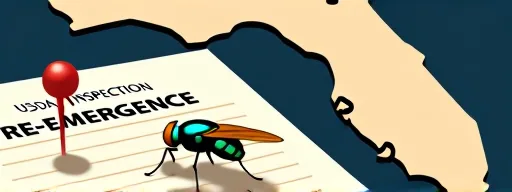
The sudden reappearance of a flesh-eating parasite eradicated from the United States more than half a century ago has jolted authorities and the cattle industry into emergency action. Texas Governor Greg Abbott declared a state of disaster in Zavala and Uvalde counties after a three-week-old calf in La Pryor tested positive for the New World screwworm—the first confirmed detection in American livestock since the 1960s. The parasite’s larvae burrow into the living tissue of warm-blooded animals, often leaving gaping, potentially fatal wounds. Officials immediately imposed a quarantine on affected premises, seeking to contain a threat that, viewed from Washington, could inflict billions of dollars in damage if it spreads unchecked.\n\nThe detection marks the leading edge of a northward march that has been building for over a year. The screwworm fly has been advancing from Colombia through Central America and into Mexico, drawing repeated warnings from US and Mexican agricultural officials. In Guanajuato, health authorities confirmed two human cases in elderly residents, although both were treated successfully; more than 200 other animal cases have been logged in that Mexican state alone. Ranchers in southern Texas had been bracing for the arrival, and the confirmation—some 50 miles from the border—has vindicated their fears. The parasite’s reappearance also reflects a broader pattern: invasive species cost the United States staggering sums each year, from degraded farmland to compromised water systems.\n\nThe response has been swift and multi-layered, with implications beyond American borders. Governor Abbott vowed to accelerate construction of a $750 million sterile-fly breeding facility near Edinburg, Texas, a cornerstone of the eradication strategy that relies on releasing millions of sterilised males to crash the fly population. For the same reason, Canada announced it would temporarily bar imports of livestock that have been in Texas within the previous 21 days, a precaution that underscores fears of a pan-North American outbreak. The US Department of Agriculture, meanwhile, is drawing on emergency funds and coordinating with Mexican counterparts to track the parasite’s movement.\n\nAnalysts in London note that the case tests the resilience of modern biosecurity regimes against old scourges, especially as climate change and global commerce expand the range of invasive organisms. The cattle industry, worth roughly $113 billion in the United States, is particularly exposed; beyond the immediate costs of animal deaths, trade restrictions can ripple through supply chains. Scientists estimate that a large-scale outbreak could cost over $3 billion. The race to stand up the sterile-fly factory, not expected to begin full operations for more than a year, is now seen as critical. For American ranchers and veterinary officials, the battle against a once-vanquished worm has become an urgent test of memory, money, and international cooperation.
How the same story is told elsewhere.
Decades after eradication, the flesh-eating parasite re-emerges in Texas, threatening livestock security and agricultural trade. Canada immediately restricts imports while the US deploys sterile flies and quarantines for containment. At stake are a multibillion-dollar beef industry and the ecological stability of entire regions.
Texas declares an emergency over the screwworm, a parasite absent for decades and now tied to cross-border movement. As ranchers remain on high alert, human cases in Mexico fuel anxiety and skepticism grows about US containment capacity. Sterile flies become the last resort in a race against time.
A horror-movie flesh-eating worm shocks the US: after decades, the killer parasite strikes a calf in Texas, triggering panic over a potential billion-dollar outbreak. The fight is on with sterile flies and quarantines, but the shock to American food production is palpable.
This story appeared in
12 sources · 3 languages · 24h window