China's Quota Squeeze Hits Australian Beef as South America Supplies Record Volumes
China warns of a 55% tariff on Australian beef within days as import caps near, while Brazilian and Argentine agricultural exports to the Asian market reach new highs.
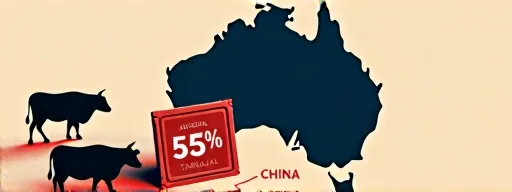
Australia is hours away from a steep new tariff on its beef exports to China, after Beijing warned that an annual import quota introduced at the start of the year is about to be breached. Once the cap is exceeded, shipments will be subject to an additional 55 per cent duty, a move that threatens to price Australian product out of one of its largest overseas markets. The trigger is the rapid fill of a country-specific quota, with Australian exporters already having used 90 per cent of the allocated volume. The looming impost underscores the increasingly managed nature of China's agricultural trade, where Beijing uses quantitative restrictions to calibrate supply and pressure suppliers.
The warning from Beijing contrasts sharply with the performance of South American rivals. Brazilian beef exports surged to 297,000 tonnes in May, an 18 per cent jump on the same month last year, with China alone taking 157,600 tonnes. The sector has so far escaped new US tariffs, though it faces its own quota pressures from China and a potential European Union veto over environmental standards. Meanwhile, Argentina reported a 161 per cent leap in pork export values and a 29 per cent rise for eggs in the first four months of 2026, with China among the top destinations. Brazilian cotton has also set a record for May exports, reinforcing the broader agri-export boom that is helping to offset patchier demand elsewhere.
Amid these commercial cross-currents, there are signs that the Sino-Australian agricultural relationship is not purely adversarial. Australian bull semen exports have quietly resumed after a five-year hiatus, with 24,000 straws of Wagyu and dairy genetics shipped to China since April. The trade, driven by China's appetite for premium beef and more efficient farming, points to a deepening of ties at the higher end of the value chain even as commodity flows face friction. For some Australian producers, the genetic trade offers an alternative pathway to the Chinese market that is less exposed to blanket tariffs.
Viewed from Beijing, the quota mechanism is a powerful tool to manage food security while diversifying import sources. Analysts note that by squeezing traditional suppliers such as Australia, China incentivises investment in alternative origins—a strategy that dovetails with its Belt and Road infrastructure push into Latin America. For Australian exporters, the immediate task is to find new markets for beef that may soon become uncompetitive in China, while for Brazil and Argentina the challenge will be to sustain productivity gains without provoking their own trade friction. The world's largest agricultural import market is redrawing the map, and suppliers are scrambling to adapt.
How the same story is told elsewhere.
Australia is suddenly under threat of a 55% Chinese tariff on beef, with the annual quota nearly filled. The move is seen as a punitive squeeze on a key trading partner, jeopardizing a vital export market. The reopening of bull semen exports is a minor bright spot in a picture dominated by tariff alarm.
Brazilian beef exports surged 18% in May to 297,000 tonnes, while cotton hit an all-time monthly record. Argentina saw pork and egg exports leap more than 160%. The region pragmatically celebrates its agro-industrial strength, capitalizing on expanding global demand.
China manages beef import quotas to balance domestic supply and protect local farmers, applying tariffs only after predetermined thresholds are exceeded. The selective import of high-quality bovine genetics, such as Australian bull semen, supports national herd improvement. This is a routine trade policy tool, not a hostile act, aimed at long-term food security.
This story appeared in
4 sources · 2 languages · 24h window