Spielberg’s Alien Return Coincides with Real-World Hunt for Life
As Steven Spielberg’s Disclosure Day divides critics, scientists unearth clues to life’s origins in Egypt’s desert and Cambodian caves, while astrobiologists grow less sceptical about alien existence.
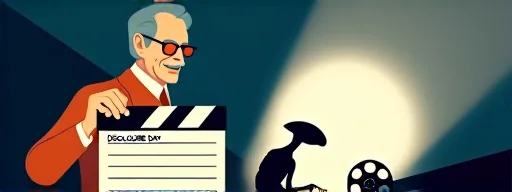
Steven Spielberg’s Disclosure Day, the final chapter in a loose extraterrestrial trilogy begun with Close Encounters of the Third Kind and E.T., has landed in cinemas across continents this week, reopening a conversation the director first framed nearly five decades ago. The film, which imagines a cybersecurity expert attempting to expose a decades-long government cover‑up of alien contact, arrives not in a vacuum but at a moment when laboratories and field expeditions are quietly transforming the same existential question: are we alone? Viewed from Paris, the sociologist Pierre Lagrange argues that Spielberg’s work channels an almost eighty‑year evolution of ufological pop culture and shifting public trust in institutions, a theme echoed by the director’s own admission that the film completes a personal arc of wonder.
The cinematic return to the cosmos is mirrored by an unconnected but striking series of real‑world discoveries. In Egypt’s Eastern Desert, a team led by palaeontologist Hesham Salam has excavated a 62‑million‑year‑old marine ecosystem at Qreiya 3, revealing how life rebounded after the asteroid that wiped out the dinosaurs — a finding that illuminates the resilience of biology in catastrophic conditions. Across the Indian Ocean, researchers in the Western Ghats have described Eechathalakenda incognita, a cryptic fish species misidentified for seventy years, while a survey of 64 limestone caves in Cambodia’s Battambang province has added a turquoise pit viper, a flying snake and previously undescribed geckos to the inventory of life. These incremental expansions of the tree of life on Earth run parallel to a global survey of astrobiologists, who report that scepticism about extraterrestrial existence has measurably receded after tantalising biosignature detections on planet K2‑18b.
Critical reception to Spielberg’s latest blockbuster has fractured along generational and regional lines. French reviewers concede that only devoted admirers will fully forgive a narrative that “remains well below his finest achievements”. Italian commentary is notably sharper, dismissing the picture as a relic from “dusty neighbourhood supermarkets” that “loses the wonder” and smacks of a director who has lost touch with a fast‑moving era. Swedish critics are equally unforgiving, decrying a “substanslös soppa” — a substance‑less soup of sentimental piano and conspiracy tropes. Yet in London, a warmer reading praises an “exquisitely entertaining ride” anchored by Emily Blunt’s performance, and Brazilian observers detect the “optimistic innocence” that once defined the director’s work. American analysis, meanwhile, finds in Disclosure Day a deliberate allegory for a fractured present, a plea that admitting contact with the other might still unite a divided humanity.
What emerges from this multi‑continental mosaic is a cultural moment in which art and science feed the same appetite. The film’s conspiracy‑laden premise — a secret agency suppressing evidence for eight decades — draws on real‑world distrust in authority that the Roman premiere spectacle merely amplified. At the same time, laboratories are rewriting the origin stories of life’s building blocks, with new research suggesting phosphorus and nitrogen reached Earth from the inner solar system rather than distant meteorites. As the credits roll on Spielberg’s alien trilogy, the search for the unknown remains stubbornly collaborative: in satellite‑beamed biosignatures, in the limestone karst of Cambodia, and in the fossil‑rich sediments of a vanished sea. The question endures; only the tools have changed.
How the same story is told elsewhere.
Spielberg's latest alien film is met with skepticism and irony: it's a substance-less soup, a work showing a director stuck in childhood memories, unable to recapture past magic. The aging of his cinema is likened to a dusty old supermarket where the products on the shelves have gone stale.
The film is read as an allegory of the present moment: Spielberg hasn't abandoned hope for humanity and uses the alien sci-fi to comment on the political and social issues of our time. Rather than a nostalgic throwback, the work reveals a director still capable of delivering timely and thoughtful messages.
The film reveals a massive secret of the universe hidden by world authorities for decades: a battle between truth and power interests. It's a sci-fi thriller that warns about what could happen if the truth about aliens finally came to light.
This story appeared in
17 sources · 8 languages · 24h window