Putin’s Elite Evade Jet Sanctions Through Offshore Networks
A Wall Street Journal probe reveals how Putin's allies continue to fly new Western business jets, using shell companies and registrations in neutral countries to bypass sanctions.
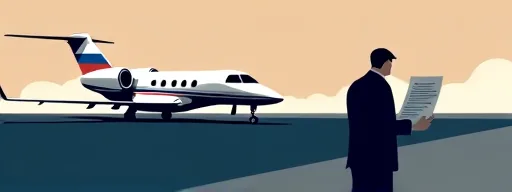
An investigation by The Wall Street Journal has exposed how members of Vladimir Putin’s inner circle are circumventing Western sanctions to continue flying new business jets manufactured in the United States and Canada. Using a network of intermediary companies, offshore registrations, and transactions via countries that have not imposed flight bans or export controls, high-ranking Russian officials and businessmen are acquiring and operating Bombardier and Gulfstream aircraft with apparent impunity.
Among those named is Sergei Chemezov, the head of state-owned defence conglomerate Rostec and a longstanding Putin ally. According to the inquiry, Chemezov regularly uses a Bombardier Global 7500, valued at approximately $75 million, to travel to Dubai, Turkey, and destinations in Southeast Asia. Prior to Russia’s full-scale invasion of Ukraine, he had frequently visited Spain, where his family owned properties; now, like several other oligarchs, he has shifted his base to the UAE, reportedly using a villa on Dubai’s Palm Jumeirah archipelago. Arkady Rotenberg, another close associate of the Kremlin, has been flying two Bombardier Global jets since late 2022.
The aircraft are typically purchased on the secondary market and registered in states that remain outside the sanctions regime, such as the United Arab Emirates, Oman, Kazakhstan, and South Africa. Viewed from European capitals, the revelations highlight the persistent loopholes in the architecture of sanctions. Analysts in London note that the involvement of opaque corporate structures and non‑aligned jurisdictions makes enforcement exceedingly difficult, as the true beneficiary often remains hidden behind complex ownership chains. The Russian elite’s adaptation—swapping European destinations for new playgrounds in the Gulf and Asia—also reflects a broader geopolitical realignment and resilience in the face of economic warfare.
The persistence of such luxuries among the Kremlin‑affiliated raises uncomfortable questions about the effectiveness of sanctions as a tool of pressure. As one senior diplomat from a EU member state observed privately, “We close one door and they build a tunnel.” With the war in Ukraine grinding into its third year and Western governments seeking to tighten restrictions, the cat-and-mouse game between sanctioning authorities and the facilitators of the Russian elite looks set to intensify. The case of business jets may be emblematic of a deeper problem: while the symbolic value of sanctions is high, their practical impact is only as strong as the weakest link in the global compliance chain.
This story appeared in
5 sources · 3 languages · 24h window