Orbán’s fall shakes European illiberalism as new challengers rise in east
The electoral defeat of Viktor Orbán has left the far right orphaned, but the path to dismantling his autocracy is fraught, while Bulgaria and Poland chart their own turbulent courses.
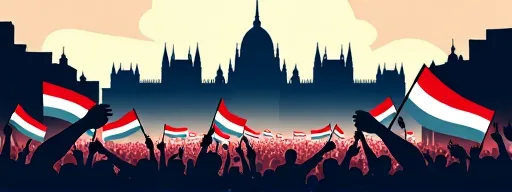
The streets of Budapest still echoed with a raw, almost disbelieving euphoria days after the vote. Thousands of young Hungarians packed the thoroughfares as if spilling from a music festival, the roar so loud that a reporter could not hear the voices he was recording without a wireless microphone [A1]. The ousting of Viktor Orbán after sixteen uninterrupted years in power has been received as a catharsis, a moment when the nation believed a corrupt, illiberal apparatus might be swept away as if by a violent gust of wind [A2].
Yet the task facing the victor, Péter Magyar, is immense. Analysts in Warsaw point to Poland’s own halting efforts to dismantle the legal and media machinery of a populist decade [A2]. Orbán’s “illiberal state” was more deeply embedded: partisan judges, captured public broadcasters, a crony economy. Magyar is demanding rapid purges of Orbán loyalists from the state apparatus, and has adopted a tone that is less magnanimous than peremptory [A5]. The outgoing leader, speaking for the first time at length since his defeat, sounded oddly serene, vowing a comprehensive renewal of his Fidesz party and offering restrained criticism of his opponent [A5]. This studied calm did little to arrest a wider continental reckoning: from Madrid to Paris, the defeat has been read as a decapitation blow to the European far-right, reminiscent of the Hollywood trope in which a fallen Apache chief causes the whole war party to disperse [A4].
If Hungary’s vote suggests a liberal pendulum swing, the political weather in neighbouring Bulgaria points in the opposite direction. In Sunday’s snap parliamentary elections — the eighth in five years — the frontrunner is Rumen Radev, a former general and eurosceptic president who stepped down early to seek the premiership [A3][A7]. His hastily assembled coalition, “Progressive Bulgaria,” is polling at 30–40 percent, far ahead of any rival, on a promise to smash a corrupt oligarchy that he himself depicts as a mafia network draped in democratic trappings [A3]. Yet Radev is widely seen as a “Putin sympathiser” who advocates restoring dialogue with Moscow, leading analysts in Moscow to label him a potential “new Orbán” [A7]. The irony is sharp: just as Hungary’s autocrat falls, Bulgaria contemplates electing one of his ideological kin.
The picture is further complicated by Poland, where President Karol Nawrocki has launched a bid to rewrite the 1997 constitution. Declaring that the founding text “is exhausting itself before our eyes,” he called for a clearer separation of executive powers between president and prime minister and signalled his preference for a presidential system [A6]. A special council is to be convened to draft a new basic law. The initiative, viewed from Brussels with unease, reveals a region where the institutional rules of the game remain very much in play.
What emerges across Central and Eastern Europe is not a single narrative but a fractured landscape. Hungary’s liberal counter-revolution is real but fragile, and Orbán, feeling “younger than ever,” intends to remain a force [A5]. Bulgaria may soon test whether the authoritarian model can be reborn under a different flag, while Poland reopens fundamental questions about the architecture of its democracy. The defeat of one illiberal chief has not extinguished the fire; it has scattered embers that could ignite elsewhere.
This story appeared in
6 sources · 4 languages · 24h window