Netanyahu and New Mossad Chief Vow to End Iranian Regime
At the handover ceremony, Israeli leaders pledged to prevent nuclear acquisition and openly embraced regime change, signaling an intensification of the covert war against Tehran.
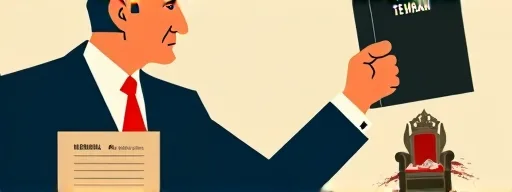
In a choreographed display of continuity and resolve, Prime Minister Benjamin Netanyahu and the incoming director of the Mossad, Roman Gofman, used the intelligence agency’s formal handover ceremony on Tuesday to issue their most explicit threats yet against Iran. Standing before the assembled staff in Tel Aviv, Netanyahu declared that “this terrifying regime will end up perishing from the world, and we will help it reach that goal,” while instructing Gofman to ensure the Mossad remains “at the forefront of the struggle against Iranian aggression.” Gofman, a veteran of the agency’s covert operations, pledged that “the heart of Mossad beats in covert operations against its targets,” and that he would protect that mission “at any cost.” The rhetorical embrace of regime change marked a departure from the more ambiguous language often used by Israeli officials.\n\nFor the Israeli security establishment, the ceremony underscored a perception of strategic momentum. Gofman told his audience that the Iranian-led Shiite axis had “suffered a tough blow” in recent campaigns and that Israel had “altered the balance of power for the entire region.” The Jerusalem-based press framed the event around the new chief’s assessment that the Mossad’s silent, invisible work had reshaped the Middle Eastern chessboard. Netanyahu’s directives leave little room for misinterpretation: the intelligence service is to prevent Iran from acquiring a nuclear weapon at all costs, a mission he believes is far from over.\n\nViewed from other capitals, the speeches revealed diverging interpretations. Iranian media, such as the London-based Iran International, highlighted the unmistakable regime-change intent, quoting former Mossad chief David Barnea and Netanyahu speaking of Iran’s eventual “disappearance” as an achievable target. For Tehran, this narrative serves to justify its own maximalist positions. Arab outlets, including Sky News Arabia and Al-Modon, led with Netanyahu’s vow to prevent a nuclear Iran and his warning against Tehran turning “the clock back,” often sidelining the regime-change rhetoric. Analysts in Amman and Cairo note that such open talk of toppling the government in Tehran unsettles Arab states that fear a wider conflagration, even as they share Israel’s concerns about Iranian nuclear ambitions.\n\nThe ceremony signals that under Gofman, the Mossad is likely to intensify its shadow war, combining sabotage, cyber operations, and targeted killings. Yet the explicit adoption of regime change as a public goal carries risks. London-based analysts observe that it undermines diplomatic tracks and could unify disparate Iranian factions against an existential threat. From Washington, where the Biden administration has sought a diplomatic solution, the Israeli rhetoric creates potential friction, even if the military coordination against Iranian proxies remains robust. The new Mossad chief’s tenure begins, therefore, at a moment of both strategic opportunity and significant peril, with the boundaries between covert action and open political warfare increasingly blurred.
How the same story is told elsewhere.
The swearing-in of the new Mossad chief was framed as the moment to underline that the Iranian regime's days are numbered, having suffered a severe blow at the hands of Israeli intelligence. The premier recalled the strategic reversal imposed on Tehran and vowed that the Jewish state will help bring about the downfall of the ayatollahs.
Gulf outlets reported the new instructions given to the Mossad chief: prevent Tehran from acquiring nuclear weapons and continue the struggle against Iranian aggression. The coverage quoted the Israeli premier describing Iran's leadership as a terrifying regime that will ultimately vanish.
The European press noted that the Mossad appointment was contested and required Supreme Court approval. The ceremony saw a renewed warning to Tehran, with the claim that the regime's foundations are already cracked; the tone remains that of an observer taking note of bellicose rhetoric not without controversy.
The Arab-Levantine press presented the statements as yet another Israeli threat, using verbs like ‘claim’ to signal distance. The Israeli premier is depicted as determined to prevent Iran from rebuilding its nuclear capabilities, in a framing that portrays Tel Aviv’s leadership as a threatening actor promising the downfall of the theocratic regime.
This story appeared in
6 sources · 4 languages · 24h window