Leo XIV's Spanish Journey Tests His Dual Challenge to Trump and Digital Technocracy
The first major European trip of the American pope comes as his anti-deportation stance and AI encyclical reshape the Vatican’s geopolitical and doctrinal identity.
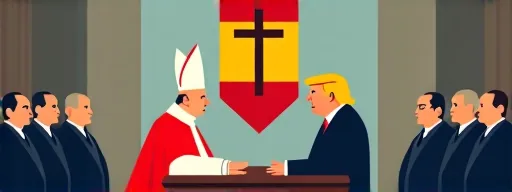
Pope Leo XIV arrives in Spain on 6 June for a six-day visit that is much more than a pastoral tour. The American pontiff’s first major European foray, officially detailed by Vatican spokesman Matteo Bruni, takes in Madrid, Barcelona and the Canary Islands — a deliberate itinerary that touches Spain’s political heart, its separatist tensions and the migration frontline. Church historians note that papal travel has been a calibrated instrument of soft power since Paul VI first boarded an aircraft in 1964, and Leo XIV’s choice of destinations signals his willingness to wade into Europe’s thorniest debates.
The visit unfolds against a backdrop of remarkable popular support for the Pope’s combative stance towards Donald Trump. A survey by the Spanish firm 40dB shows that almost 70 per cent of Spaniards back his rejection of war as a solution to conflicts, and 57 per cent endorse his criticism of mass deportations. Yet the country he encounters is, as a Swiss newspaper observes, far less Catholic than its reputation — a society where Church, state and citizens still negotiate their uneasy coexistence. In Madrid, however, city authorities are bracing for 1.8 million people at two open-air events, and over half a million have registered for papal masses. The electric ‘popemobile’ — a glass-encased vehicle that has been a security fixture since the 1981 assassination attempt on John Paul II — will traverse streets decked with the yellow and white of the Vatican.
Simultaneously, Leo XIV is asserting a doctrinal counterweight to digital technocracy. His first encyclical, Magnifica Humanitas, signed on 15 May, the anniversary of Leo XIII’s Rerum Novarum, has been hailed by some as a refoundation of Catholic Social Teaching. The Italian scholar Paolo Benanti, in a new book, maps how computational power creates invisible chains — data as currency, algorithms as legislators, platforms as mass-control architectures. Analysts in Rome note that the encyclical marks a departure: while secular politics quarrels over how to regulate artificial intelligence, the Vatican questions the paradigm itself, positioning the Pope as the lone global voice against the technocratic consensus. This stance resonates especially in Spain, where the survey found that nearly 80 per cent demand Church modernisation.
Observers in London and Brussels detect a coherent strategy. The Pope’s anti-Trump posture and his AI critique are not separate; they reflect a recalibrated Catholic social doctrine that emphasises the common good, subsidiarity and justice in the face of both authoritarian nationalism and unbridled technology. The Spanish trip will test whether this dual message can consolidate his moral authority. The Canary Islands stop, for instance, directly confronts the migration crisis at Europe’s southern border, a topic on which the Pope has been as vociferous as on deportations. The Barcelona leg, set in an Olympic stadium, inevitably touches Catalonia’s complex identity, where the Church has historically been both a unifying and dividing force.
As Leo XIV navigates a hyper-securitised Madrid, the logistical strain — 13,000 police, 18,000 volunteers, shuttered metro stations — will be matched by the political theatre. The real measure of success, however, lies beyond the cheering crowds. The pontificate’s early trajectory suggests a Vatican willing to wield its soft power with unapologetic clarity, confronting the great disruptions of the age: algorithmic control, militarised borders and the erosion of human dignity. Whether this resonates in an increasingly secular and fragmented West remains the open question that the Spanish journey may begin to answer.
How the same story is told elsewhere.
The European continental press frames Pope Leo XIV as a moral bulwark against Trump's authoritarian far right, bolstered by majority support in Spain. It also celebrates his encyclical as the most radical challenge to digital technocracy, while noting the visit reveals Spain's fading Catholic identity and causes major traffic disruptions.
The Latin American press covers Leo XIV's Spain trip by focusing on the electric popemobile, the official itinerary, and the encyclical's reorganization of Catholic social teaching. Its tone is detached and factual, avoiding political controversy.
This story appeared in
9 sources · 3 languages · 24h window