Massive Whale Necropolis Dating Back 5.3 Million Years Found in Indian Ocean
A Chinese-led expedition has uncovered the world’s largest whale graveyard, stretching 1,200km deep under the Indian Ocean and sustaining an ecosystem possibly containing species new to science.
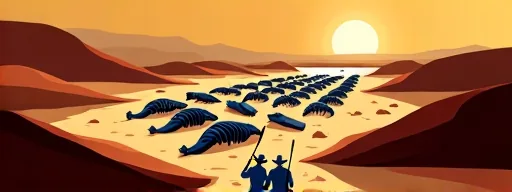
A Chinese-led expedition has discovered the largest and oldest whale graveyard ever recorded, stretching across 1,200 kilometres of the seafloor in the southeastern Indian Ocean and dating back 5.3 million years. The necropolis, located in the Diamantina fracture zone west of Australia at depths of up to 7,000 metres, contains nearly 500 fossilised cetacean skeletons, along with five whales still decomposing on the seabed. The find, published in Nature, has astonished the scientific community by revealing an entire ecosystem that thrives on the decaying remains.
Viewed from Moscow, the site’s registration of 476 fossil specimens, including a previously unknown and now-extinct whale species, was especially notable. Chinese state media emphasised that the survey involved 32 dives by the submersible Fendouzhe, a collaboration between the Chinese Academy of Sciences and researchers from Italy and New Zealand. Outlets from Indonesia to Sweden highlighted the peculiar V-shaped seafloor trough that funnels dead whales into the depths, turning a prime feeding ground into a natural trap that has operated for millions of years.
“Discovering a necropolis of this scale was completely unexpected,” Xiaotong Peng, a study co-author from the Chinese academy, told Nature. American palaeontologist Stephen Godfrey, speaking to Spanish-language media, compared the find to the 1977 detection of life-rich hydrothermal vents, calling it “truly unique.” French and Portuguese reports stressed that the remains support an array of organisms, including bone-eating worms and molluscs, many of which may be entirely new to science. The oldest fossil, at 5.3 million years, pushes back the known timeline of such deep-sea ecosystems.
Australian broadcasters noted the graveyard lies in international waters off the continent’s west coast, a proximity that has prompted keen interest from Canberra’s scientific agencies. Researchers are now working to identify new species collected during the dives. The discovery not only rewrites understanding of whale-fall ecology but also casts light on the vast, unexplored biodiversity of the abyss at a time when seabed mining and climate change increasingly menace these fragile habitats. For Beijing, the achievement underscores its growing capacity to lead deep-sea research, a domain traditionally dominated by Western nations.
How the same story is told elsewhere.
A whale necropolis dating back 5.3 million years has been identified on the floor of the southeastern Indian Ocean. Stretching 1,200 kilometres across the Diamantina Fracture Zone, at depths between 4,200 and 7,000 metres, it is the largest and deepest such deposit ever found. An international team led by the Institute of Deep-Sea Science and Engineering published the analysis in Nature, noting the discovery sheds new light on abyssal ecosystems.
An enormous whale graveyard, probably the largest scientific discovery of its kind, stretches 1,200 kilometres across the Indian Ocean floor and may hold up to 10 million carcasses. Researchers, led by the Chinese Academy of Sciences with Italian and New Zealand colleagues, are astonished by the find: it contains remains dating back 5.3 million years and could harbour marine species never before seen. This cemetery opens a new window into how life survives in the planet's most extreme environments.
The world's largest whale cemetery has been discovered off the coast of Australia, at depths reaching 7,000 metres in the Diamantina Zone. Stretching 1,200 kilometres across the southeastern Indian Ocean seafloor, the site contains massive accumulations of whale remains, including modern whale-fall communities. The findings, published in Nature, were based on research that identified both recent and ancient carcasses in the deep-sea graveyard.
This story appeared in
15 sources · 2 languages · 24h window