Israel Defies Trump with Retaliatory Strikes on Iran as Truce Collapses
Israel launched airstrikes on military targets in Iran early Monday, hours after Tehran fired ballistic missiles at Israel for the first time since the April ceasefire, shattering the fragile truce.
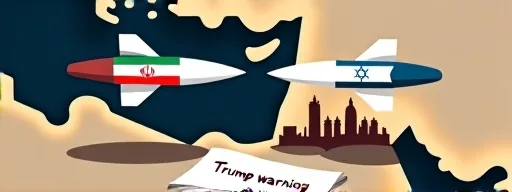
Israel struck military targets across western and central Iran in the early hours of Monday, defying a direct appeal by US President Donald Trump for restraint and plunging the Middle East back into open confrontation. The Israeli air force raids followed Iran’s launch of several ballistic missiles towards northern Israel late on Sunday, an exchange that marks the first direct cross‑border fire since a ceasefire took effect on 8 April. Explosions were reported in Tehran, Isfahan and Tabriz, while Israeli authorities said all eleven incoming missiles were intercepted without casualties. The Israeli military said its strikes targeted “defence systems” and other infrastructure, and described Iran’s attack as “a serious mistake.”
The immediate trigger was an Israeli airstrike on Beirut’s southern suburbs on Sunday morning, which killed at least two people and wounded eleven, including children. Iran’s Islamic Revolutionary Guard Corps declared it had fired on the Ramat David airbase in northern Israel “in response to the regime’s crimes against the oppressed in Tyre and Nabatieh,” and warned that further Israeli “aggression” in Lebanon would be met with a larger response. Viewed from Tehran, the April truce was conditional on a complete cessation of hostilities on all fronts, yet Israel had continued operations against Hezbollah in Lebanon, a violation Iran was no longer prepared to tolerate.
From Washington, Trump publicly sought to contain the escalation. “I’m calling Bibi right now and telling him not to respond,” he told Axios, adding that both sides “had their fun” and that new strikes would not affect his diplomatic engagement with Iran. Trump’s assertion that the Israeli prime minister “doesn’t call the shots” underscored the deepening rift between the two allies. Yet hours later, Israeli far‑right security minister Itamar Ben‑Gvir wrote on X that “Tehran must burn tonight,” and opposition leader Naftali Bennett characterised the moment as a test of Israel’s resolve. The military, waiting only for “a green light,” proceeded with the retaliatory operation.
The exchange swiftly drew in other actors. Iran‑aligned Houthi rebels in Yemen fired missiles at central Israel, triggering sirens in Tel Aviv, Jerusalem and elsewhere. Iraq shut its airspace for seventy‑two hours, Syria closed its southern air corridor, and Iran sealed its western flight‑information region. Oil prices surged on fears that a conflict many had hoped to contain was now spilling uncontrollably across borders. No casualties were reported on either side overnight, but the geographical scope of the alerts and closures signalled that the war, now entering its hundredth day, had entered a dangerous new phase.
Analysts in European capitals see the sequence as the collapse of the April ceasefire and the consolidation of what a German broadsheet termed Iran’s “new equation”: that strikes on Iranian proxies in Lebanon will henceforth be treated as attacks on Iran itself, meriting direct retaliation. Trump’s strategy of pursuing a separate deal with Tehran while expecting Israel to absorb attacks has manifestly failed. With the truce formally broken and both leaderships trading threats, the risk of a full‑scale regional war—drawing in Lebanon, Yemen and potentially beyond—has rarely been higher.
How the same story is told elsewhere.
Iran's missile strike on Israel was a direct response to Israeli crimes in southern Lebanon. Despite Trump's explicit ban, Israel launched airstrikes on Tehran, with officials threatening that 'Tehran must burn.' The April ceasefire has fully collapsed, revealing Washington's inability to control its ally.
Israel's bombing of Beirut, causing mass casualties and forced displacement in southern Lebanon, provoked Iran's first missile attack since the April truce. Iran framed the strike as a warning in defense of the oppressed Lebanese people. The escalation quickly spread, drawing in Houthi missiles and forcing neighboring countries to close their airspace.
A two-month-old ceasefire collapsed as Iran and Israel exchanged direct fire, defying President Trump's urgent call for restraint. Israel's strikes on Iranian military targets, in response to Tehran's missile barrage, threaten to reignite a full-scale regional war. The White House is grappling with a diplomatic crisis as its peace initiative founders amid the renewed violence.
This story appeared in
37 sources · 8 languages · 24h window