Historic peacetime decline looms as Europe’s demographic fault lines widen
France’s population is projected to shrink for the first time outside war, while Swedish regions bleed young people and Germany leans on immigration to sustain numbers.
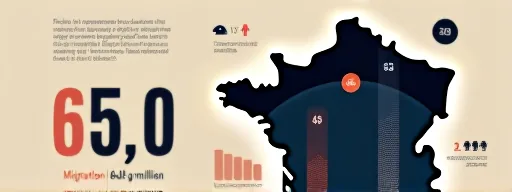
For the first time in modern French history outside armed conflict, the national population is on course to enter a sustained decline. According to the central scenario of the national statistics institute Insee, the number of inhabitants will peak around 2037 before falling to 65.9 million by 2070, a drop of 3.2 million from the 2026 level. Loup Wolff, head of demographic and social studies at Insee, described the trajectory as “historic” and “unprecedented”, noting that no comparable peacetime contraction exists in the record. The shift reflects a convergence of sub-replacement fertility and an ageing structure that progressively erodes natural increase.
In northern Europe, the demographic squeeze is already being felt acutely at the regional level. Sweden’s Västernorrland county lost more than 3,000 residents between 2021 and 2025, while the number of children and young people fell by 2,403 and the over-65 cohort grew by 1,608. Projections out to 2040 suggest a further loss of 14,360 people, with the under-twenties shrinking by nearly 9,000. The pattern is echoed in the southern municipality of Karlskrona, where population decline has spurred centre-left parties to demand a temporary population commission, warning that falling tax revenues will hollow out local services. Local officials in Stockholm and regional authorities across the country argue the challenge is not merely numerical but fiscal: fewer working-age taxpayers, more elderly needing care.
Germany, by contrast, has so far managed to keep its total population roughly stable at around 83.5 million, even though the fertility rate languishes at 1.35 births per woman, well below the replacement threshold of 2.1. The buffer has come from migration and naturalisations. Berlin’s liberalisation of citizenship laws has become a demographic instrument, allowing the state to offset natural decrease and sustain the labour force. Analysts in Frankfurt note that immigration has transformed Germany’s demographic outlook from one of precipitate decline to sluggish stagnation, though the underlying ageing process remains a long-term pressure on pension and health systems.
Yet demographic change does not only mean depopulation. In Switzerland, the canton of Zurich is preparing to vote on a housing protection initiative that aims to shield tenants from displacement while still permitting urban densification and renewal. The debate, as framed by Zurich’s mayor Raphael Golta, rejects an “all or nothing” choice between rampant construction and preservation, seeking instead a pragmatic path that acknowledges intensifying pressure on housing stock. Viewed from Geneva, the initiative illustrates how even prosperous, growing regions are grappling with the spatial and social consequences of shifting demography.
The cross-continental picture is one of divergence. France’s looming national decline, Sweden’s emptying regions, Germany’s migration-dependent equilibrium and Switzerland’s urban growth tensions all suggest that European governments will need bespoke, politically deft responses. The demographic transition is no longer a distant abstraction; it is rearranging local tax bases, housing markets and welfare compacts in real time.
This story appeared in
6 sources · 4 languages · 24h window