EU proposes visa ban for all Russian war veterans and freezes oil price cap
The European Union unveiled its 21st sanctions package, proposing a blanket entry ban on Russian soldiers and suspending adjustments to the crude oil price cap amid Middle East turmoil.
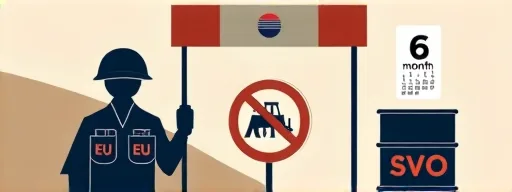
The European Commission presented its twenty-first sanctions package against Russia on Tuesday, distinguished by a first-ever blanket visa ban on all members of the Russian armed forces who have served since the full-scale invasion of Ukraine. Alongside the entry prohibition, Brussels intends to freeze its price cap on Russian crude oil at around $44 per barrel until January 2027, suspending a mechanism designed to track market trends. Commission President Ursula von der Leyen, unveiling the measures with foreign policy chief Kaja Kallas, stated that the cap was not built for shocks like the closure of the Strait of Hormuz, and that holding it steady would sustain pressure on Moscow’s energy revenues while the oil market stabilises.
The financial thrust of the package is considerable. Diplomatic sources told Reuters that up to ninety Russian banks will be added to the sanctions list, pushing the total number of restricted credit institutions above one hundred—more than half of all Russian banks active in international transactions. The Commission is also proposing a transaction ban on thirty-one banks and a sweeping prohibition on crypto-asset services, targeting eleven cryptocurrency platforms accused of helping the Kremlin evade existing restrictions. For the first time, a full ban on such services will apply to third countries hosting complicit platforms. In parallel, thirty additional vessels from Russia’s “shadow fleet” used to smuggle oil will be blacklisted, joining 632 already sanctioned. Export controls will be extended to fifty companies in China, Turkey, Kyrgyzstan, Kazakhstan, the UAE and India, while more than thirty firms linked to drone manufacturing face new curbs.
Reaction in Moscow was dismissive. Senator Vladimir Dzhabarov commented that Europe was no longer the dream destination it once was for Russian servicemen, encapsulating the estrangement between the two sides. The oil price freeze arrives at a paradoxical moment: global crude prices have surged due to instability in the Middle East, boosting Russia’s income even as the cap remains static. European officials nonetheless maintain that sanctions are biting. Von der Leyen highlighted Russian inflation near six percent, interest rates at 14.5 percent, and the evaporation of two-thirds of the liquid assets in the country’s sovereign wealth fund, arguing that constancy is delivering results.
The package, expected to be endorsed by member states later in June, signals endurance in the economic campaign against Russia as the war grinds into its fourth year. The visa ban on potentially hundreds of thousands of former combatants—long sought by Baltic governments and recently backed by Sweden—introduces a new dimension of individual accountability, though its practical impact may prove more symbolic than disruptive. The real test lies in whether targeting the crypto ecosystem and third-country enablers can stem the leakage that has blunted past measures. Suspending the oil price adjustment mechanism buys time for markets to calm, but it also exposes the fragility of a sanctions architecture originally devised for peacetime trade disruptions rather than protracted geostrategic confrontation.
How the same story is told elsewhere.
The European Union is tightening the economic vice on Russia with the 21st sanctions package, demonstrating that sustained pressure is eroding Moscow's war economy. Measures include freezing the oil price cap adjustment due to Middle East disruptions, banning entry for all Russian veterans, and cutting off 31 more banks from the financial system. Brussels argues that these sanctions are effective, citing Russia's high inflation and mounting costs of the war.
The EU's 21st sanctions package, including a visa ban for Russian veterans, is based on the mistaken assumption that Europe remains a dream for Russian fighters. Russia dismisses the new restrictions as illegal and ineffective, noting that its armed forces and economy are adapting and that the country does not view Europe as a coveted destination. State and business outlets report the measures with detachment, often irony, emphasizing that EU attempts to isolate Russia are failing and that energy and financial sectors continue to operate despite Western pressure.
The European Union is considering a ban on entry for all Russians who participated in the Ukraine war as part of its 21st sanctions package. The proposal also targets cryptocurrency platforms used to circumvent sanctions and maintains the oil price cap. The measures are presented as continuing to heavily impact Russia's war effort, though the report remains a straightforward, detached summary of the EU's announcement without explicit endorsement.
This story appeared in
19 sources · 8 languages · 24h window