Two Dead as Kenyan Court Blocks US Ebola Quarantine Plan
Protests erupt over a planned American isolation facility at Laikipia Air Base, with President Ruto citing a direct plea from Donald Trump.
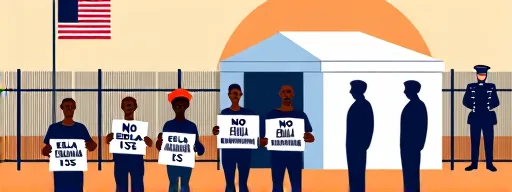
At least two people were killed in central Kenya on Monday when protests against a proposed US Ebola quarantine facility turned violent, marking a sharp escalation in public anger over a deal struck between Nairobi and Washington. Hundreds of demonstrators confronted police in the town of Nanyuki, blocking roads and hurling stones, after the government confirmed plans to host a 50‑bed unit for asymptomatic Americans exposed to the virus in the Democratic Republic of Congo or Uganda. Organisers and security sources confirmed the fatalities, though the exact circumstances remain murky; the national police spokesperson declined to comment.
The political firestorm has, for now, outstripped the operational timeline. Kenya’s High Court—responding to a petition by the Katiba Institute and the Law Society of Kenya—first suspended the project on Friday, then extended the block by a further three weeks on Tuesday, while simultaneously ordering the government to disclose its full agreement with Washington. The petitioners argued that the country’s fragile health infrastructure cannot safely house foreign patients arriving from Ebola‑affected zones, a concern amplified by the court’s demand that no such facility be “established, operationalised or permitted” until the case is heard.
From his Wajir State Lodge, President William Ruto mounted a robust defence, revealing that the plan originated with a personal request from Donald Trump. “When President Trump asked the government of Kenya to support them by having a centre in Laikipia Air Base, I gave the okay because it was an agreement with friends who have walked with Kenya for 30, 40 years,” he said. Ruto emphasised the mutual benefits of a decades‑long health partnership and insisted that ample screening—currently 3,000 travellers per day at all points of entry—has kept any Ebola case from reaching the country. The health ministry later flagged Nairobi and 24 other counties as very high‑risk, and floated a mandatory 21‑day quarantine for arrivals from ten neighbouring states, signalling a defensive posture that sits uneasily alongside the readiness to absorb US‑referred patients.
Viewed from Washington, the episode also exposes a domestic political rift. The House Foreign Affairs Committee openly criticised the administration, reminding it that specialised domestic beds exist precisely for this purpose. “The Trump administration should bring Americans home and help them, not outsource that responsibility to a foreign government,” the committee declared, pointing to earlier cuts in global health security funding that critics say weakened the very systems now being leaned upon. Analysts in London note that the juxtaposition of internal US misgivings with grassroots Kenyan resistance creates an unusually parallel front against the White House’s biosecurity diplomacy.
With the court case pending and fresh protests plausible, the Laikipia stand‑off threatens to become a broader test of how Africa’s governments navigate great‑power health partnerships. For Nairobi, the immediate quandary is legal and political: honouring a bilateral pledge while addressing a restive public that sees the arrangement as imported risk. The next three weeks will reveal whether transparency—now mandated by the bench—can defuse the anger, or whether the spectacle of American military aircraft continuing to shuttle in staff and equipment, even under a court injunction, deepens a sense of sovereigntist grievance that many in the region share.
How the same story is told elsewhere.
A proposed US Ebola quarantine site in Kenya draws fierce criticism: activists warn of a public health threat, courts demand full disclosure, while President Ruto justifies the facility as a necessary partnership following a personal appeal from Trump.
The US attempt to install an Ebola isolation unit in Kenya triggers mass protests that leave two dead. Demonstrators reject the outsourcing of health risks, and a court blocks the project, blaming Washington for imposing a dangerous facility on an unwilling country.
A US-proposed Ebola quarantine site in Kenya sparks deadly clashes, with two killed. A court extends the blockade, and Kenyans accuse Washington of offloading health risks — a typical pattern of externalizing danger onto African nations.
The building of a US Ebola quarantine centre in Kenya ignites popular fury and deadly clashes with police, killing two. A court halts the scheme, yet President Ruto stands by his personal commitment to Trump, deepening the national rift.
This story appeared in
13 sources · 7 languages · 24h window