Ukraine strikes St Petersburg as European leaders rally in London
A wave of drone strikes on Russia’s premier economic forum came as Zelenskyy met with Starmer, Macron and Merz to coordinate support, while Russian attacks killed two in Ukraine.
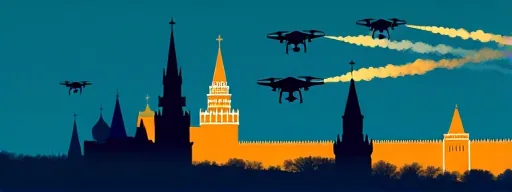
Ukraine launched a brazen drone assault on St Petersburg on Saturday, the final day of the Kremlin’s flagship economic forum, just hours after President Vladimir Putin used the stage to reject a meeting with his Ukrainian counterpart. The strike, which set a defence ministry facility ablaze and temporarily disrupted flights at Pulkovo airport, marked the second such attack on Russia’s second city in less than a week and signalled Kyiv’s determination to bring the war home to the Russian elite.
Russian air defences claimed to have intercepted more than 370 drones nationwide, including 144 over the Leningrad region, in what local officials described as an unprecedented barrage. While the full extent of the damage remained unclear, the assault underscored Ukraine’s growing capacity to strike deep into Russian territory even as Moscow’s forces press on with their own long-range drone campaign. Viewed from continental Europe, the attack reinforced the view that the conflict has entered a dangerous new phase of tit-for-tat aerial warfare with no front line.
The drone offensive unfolded as President Volodymyr Zelenskyy travelled to London for talks with British Prime Minister Sir Keir Starmer, French President Emmanuel Macron and German Chancellor Friedrich Merz. The so-called E3 grouping, which leads the ‘coalition of the willing’ for Ukraine, aimed to coordinate military aid and discuss a framework for security guarantees. European officials described the meeting as crucial to demonstrating unity and keeping pressure on Moscow, particularly with Washington’s diplomatic engagement waning. Analysts in London and Paris see the summit as part of a broader effort by European powers to take the initiative in shaping any eventual peace process.
Yet the rhythm of violence continued on the ground. Russian drone strikes killed at least two civilians in Ukraine on Sunday — a minibus driver in the Zaporizhzhia region and a man in the Dnipropetrovsk region — while other attacks wounded several. The deaths served as a grim backdrop to the diplomatic manoeuvring, with both sides demonstrating their willingness to escalate militarily even as the outlines of a possible negotiated settlement are discussed. From Middle Eastern and African vantage points, the human toll is often the central narrative, a reminder that the conflict’s costs extend far beyond the geopolitical chessboard.
The juxtaposition of high-stakes diplomacy and escalating air attacks highlights a defining characteristic of the war’s fifth year: the absence of any mutually hurting stalemate that could force concessions. With Putin refusing direct talks and the United States signalling its reluctance to lead mediation, Europe finds itself thrust into an uncomfortable front-seat role. Whether the latest military posturing has given Zelenskyy a stronger hand or merely deepened the Kremlin’s resolve remains an open question, but for now the path to peace seems as distant as ever.
How the same story is told elsewhere.
Ukraine struck deep into Russia, hitting St. Petersburg as Putin attended an economic forum, a clear message that Kyiv can bring the war home. European leaders gathered in London to intensify pressure on a Russia that is failing militarily and strategically, paving the way for future peace talks.
Ukraine launched hundreds of drones at Russia as a major international economic forum attended by Putin was wrapping up. Russian authorities intercepted the vast majority, and no serious damage was reported, though the final day of the forum was disrupted. The episode fits a pattern of reciprocal drone strikes, with St. Petersburg as the primary target.
Ukraine launched a drone barrage on St. Petersburg just as a high-profile investment forum was concluding and after President Putin declined Kyiv’s overtures for peace talks. Russian defenses shot down scores of drones, but the assault still ignited a defense ministry depot and forced the temporary closure of the city’s second-largest airport. The timing underscored a direct link between Moscow’s refusal to negotiate and Kyiv’s escalating strikes on Russian soil.
This story appeared in
17 sources · 6 languages · 24h window