Trump Refuses to Confirm Death of $1.8bn Fund, Launches Sexist Attack on Journalist
The president’s Oval Office equivocation on the ‘anti-weaponization’ fund has left its legal status in limbo, as his verbal assault on CNN’s Kaitlan Collins draws fresh condemnation.
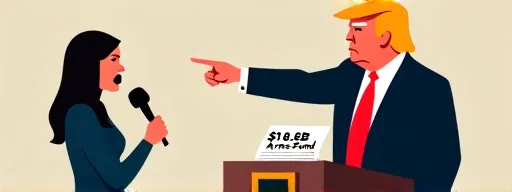
President Donald Trump sparked fresh uncertainty over his administration’s controversial $1.8 billion “anti-weaponization” fund on Wednesday, telling reporters he did not know whether it had been permanently scrapped and praising it as “a beautiful thing.” The remarks, delivered in the Oval Office, came just a day after acting Attorney General Todd Blanche said the Justice Department would abandon the initiative following a court injunction. When pressed by CNN correspondent Kaitlan Collins for clarity, Trump snapped: he accused her of having “hatred in her eyes,” derided her network as “fake news,” and repeatedly interrupted with “be quiet,” reigniting criticism of his long pattern of sexist attacks on women journalists.
The fund, formally titled the “Anti-Weaponization Fund,” was intended to compensate individuals who claimed they had been unfairly targeted by Democratic-led prosecutions. Announced in May, it immediately drew bipartisan condemnation, with critics calling it a slush fund to reward political allies and, in particular, to benefit supporters involved in the January 6 Capitol breach. A federal judge temporarily blocked it, and on Monday the Justice Department said it would “abide by the decision” while disagreeing with it. Yet Trump’s latest comments have muddied that retreat. Viewed from Washington, the episode illustrates the president’s instinct to keep policy promises alive through sheer force of rhetoric, even when his own agencies stand down.
European observers have situated the fund within a broader mosaic of ethical questions surrounding the Trump family. Spanish daily El Mundo, for example, noted this week that the aborted scheme is part of a “constant drip” of financial scandals, including irregular loans and trading operations. The Canadian public broadcaster Radio-Canada underscored the ambiguous messaging, reporting that Trump “left uncertainty hanging” over the fund’s fate. Meanwhile, London-based analysts point out that the president’s latest tirade against Collins—berating her after she sought a simple yes-or-no answer—fits a well-documented pattern. The Independent catalogued how Trump has repeatedly invoked gendered tropes to undermine female reporters, a tactic that journalists’ unions and press freedom groups have condemned as aimed at chilling critical coverage.
Despite the official pullback, the spirit of the fund appears very much alive. ABC News reported that lawyers for January 6 defendants are still preparing compensation claims through alternative legal avenues, with one attorney planning to file on behalf of 400 clients seeking at least $1 million each. Trump himself has offered encouragement, telling a podcast that such individuals “should be reimbursed.” This persistence suggests that, irrespective of the formal announcement, the ambition to reward loyalists will continue to shape the administration’s posture towards the justice system.
The coming weeks will test whether the courts and a restive Congress can force a definitive end to the initiative, or whether it will remain a rhetorical rallying point as the 2028 election cycle approaches. For international allies already uneasy with Washington’s rule-of-law trajectory, the affair reinforces concerns that institutional guardrails are being tested. As Trump toys with the fund’s resurrection, the brief exchange with a reporter may be remembered less for the outburst than for what it revealed: a president unwilling to let a cherished idea die, and a press corps determined to hold him to account.
How the same story is told elsewhere.
President Trump harshly attacked a CNN correspondent for asking whether the $1.8 billion 'anti-weaponization' fund had been permanently scrapped or merely suspended. He called the controversial initiative 'a beautiful thing' and railed against 'fake news' media, accusing them of mistreating the American people, while evading a clear commitment on the fund's future.
The Trump administration quietly walked back plans for the $1.8 billion fund, a move that fits into a steady drip of economic scandals surrounding the president and his family. From questionable tax settlements to irregular loans and no-bid contracts, the abandoned fund is just the latest in a pattern of revelations that have dogged the administration.
Acting Attorney General Todd Blanche told lawmakers the $1.8 billion 'anti-weaponization' fund was being dropped, but President Trump later refused to say it was dead, calling the concept 'a beautiful thing' and pledging to check with his lawyers. The conflicting messages drew bipartisan criticism, even as Jan. 6 defendants sought other paths to government payouts.
This story appeared in
8 sources · 4 languages · 24h window