Trump Denies Pledging ‘No New Wars’ as Iran Conflict Stalls Over Nuclear Wording
In a contentious interview, the US president insisted he never guaranteed an end to foreign wars, even as his campaign rhetoric promised ‘prosperity and peace’.
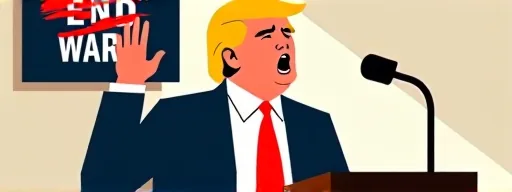
President Donald Trump has flatly rejected the notion that the ongoing military conflict with Iran constitutes a betrayal of his 2024 campaign rhetoric, insisting in an NBC interview that he “didn’t guarantee no war” and arguing that the very existence of a fortified US military justified the possibility of new engagements. The pre-taped exchange, broadcast on Sunday 7 June 2026, saw the president dismiss charges of hypocrisy as the war, launched earlier this year, drags on with no clear finish line. “First of all, I didn’t guarantee no war. Why would I have built the strongest military in the world?” Trump said, repeating a formula that his cabinet has offered for months.
The remarks sit awkwardly alongside his own campaign trail promises. Throughout the 2024 race, Trump repeatedly told supporters, “Under Trump, we will have no more wars, no more disruptions, and we will have prosperity and peace.” Viewed from Washington, the denial signals an effort to redefine the standard by which his administration is judged, shifting from an absolute pledge to a more elastic benchmark. The president now says the war will not be “endless” and should conclude soon, pinning the delay on a dispute over the precise language governing Iran’s future ability to acquire nuclear material. Analysts in London note that this semantic holdup may be a deliberate negotiating tactic, yet it risks eroding trust among allies who took the earlier “no new wars” mantra as a foundational commitment.
The interview, conducted at the president’s New Jersey property, ranged well beyond Iran. Trump also defended the now-scrapped $1.8 billion fund that would have compensated Republican allies, and he repeated baseless assertions of mass fraud in California’s drawn-out primary vote count from the previous Tuesday. These diversions, combined with the Iran denial, paint a picture of a White House juggling multiple credibility tests simultaneously. From Tehran’s perspective, the president’s backtracking is likely to be seized upon as evidence that Washington’s word cannot be relied upon in negotiations, further complicating an already fraught diplomatic landscape.
Looking ahead, the war’s trajectory remains uncertain. The president’s insistence that it will end “soon” clashes with the open-ended commitment he once derided in other administrations. For a global audience, the episode crystallises a recurring pattern: campaign pledges of restraint dissolve under the pressures of office. Whether the semantic dispute over nuclear language can be resolved quickly enough to rescue a peace deal is an open question, but the erosion of credibility may prove a more durable consequence.
How the same story is told elsewhere.
The Atlantic press frames Trump's remarks as a walk-back of his 'no new wars' campaign refrain, delivering his clarification in a dry, unadorned manner without open judgment. The piece juxtaposes the quote with news of a shelved $1.8 billion military plan, allowing readers to notice the gap between pledge and action. The tone is calm and matter-of-fact, simply registering the contradiction without amplification.
The Japanese-Korean press frames Trump's walk-back inside a rapid-fire bulletin that places the headline 'I didn't guarantee no war' alongside a cascade of crisis alerts: Xi's North Korea visit, Israel-Iran missile escalation, OPEC moves around Hormuz. The contrast creates an ironic, alarm-tinged effect around the peace pledge, implying that the world is moving in the opposite direction. The temporal horizon is strategic, and the layout turns the remark into one piece of a mosaic of global strain.
This story appeared in
4 sources · 2 languages · 24h window