Mogadishu Gunfire Erupts as President’s Extended Term Inflames Somalia’s Crisis
Mogadishu overnight gunfire as President Mohamud’s term extension prompts armed standoff with opposition, alarming global powers.
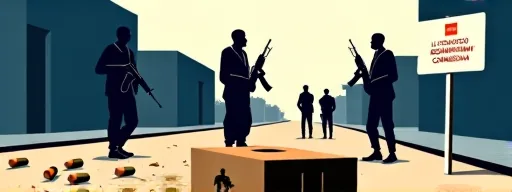
Heavy gunfire erupted in the Somali capital Mogadishu overnight Wednesday, persisting into Thursday morning, as a political crisis over President Hassan Sheikh Mohamud’s extended term in office turned violent. Government security forces and opposition fighters exchanged sustained fire in several neighbourhoods, with police declaring a “large-scale security operation” against what they termed heavily armed militias responsible for mortar attacks. In a parallel narrative, former prime minister Hassan Ali Khaire claimed government forces had attacked him as he arrived in the city to join planned anti-government protests, accusing the president of sending armed units to intimidate the opposition.
The clashes are the latest convulsion in a long-simmering dispute that began when Mohamud’s constitutional mandate expired on 15 May. Backed by a parliamentary vote in March, he extended his tenure by a year, a move opposition leaders and several regional administrations condemned as unconstitutional. The standoff deepened this week when opposition figures, including Khaire, entered Mogadishu ahead of demonstrations scheduled for Thursday. Their arrival triggered the violence, with witnesses describing columns of smoke rising over the city and residents fleeing damaged properties. “We did not sleep throughout the night because of sporadic gunfire,” Xalimo Salad, a resident of the Howl Wadaag district, told AFP, adding that “more intense gunfight broke out” the next morning.
Viewed from Western capitals, the escalation prompted swift calls for restraint. The United Nations and the United States urged all parties to de-escalate, with diplomatic sources warning that prolonged instability could imperil the fight against Al-Shabaab, the al-Qaeda-linked insurgency that controls swathes of rural Somalia. Mogadishu’s security apparatus, already stretched, now faces the risk of being diverted from counter-terrorism operations. Police claimed the operation was “nearing its end” by Thursday, though no official casualty figures were released, and sporadic shooting continued.
Analysts in Nairobi and London see the crisis as a perilous test for Somalia’s fragile federal architecture. The President’s unilateral extension has fractured trust with semi-autonomous regions, some of which have suspended cooperation with Mogadishu. Without a negotiated settlement, the path to elections – already delayed – remains blocked, threatening to deepen the political vacuum. The opposition’s willingness to mount an armed standoff in the capital underscores the depth of polarization, with the potential to draw in clan militias and unearth older fault lines.
As smoke clears over Mogadishu, the immediate priority is to avert a broader conflagration. Mediation efforts led by the African Union and regional neighbours have yet to yield a breakthrough. The crisis echoes earlier power struggles that have entangled Somalia’s international partners, who are loath to see the state collapse again. But the stark divergence between the official account of a security sweep and the opposition’s depiction of a crackdown on dissent leaves little middle ground, suggesting that Somalia’s electoral impasse will persist, even if the gunfire subsides.
How the same story is told elsewhere.
Heavy gunfire rocked the Somali capital as government troops and opposition militants clashed over the president's contested extension of his term. The opposition denounced the move as unconstitutional and called for demonstrations. Authorities described a major security operation targeting armed militias that had launched mortar strikes.
The former prime minister claimed he was targeted by government forces as the president clings to power by extending his term. The fighting plunged the country back into open crisis, prompting a warning from the United States. The constitutional reform is perceived as a means to remain in office.
Clashes erupted after the president extended his term, sparking violence in the capital. The former prime minister said he was attacked by government troops, and residents fled the fighting. Parliament had approved the constitutional amendment allowing a one-year extension.
This story appeared in
7 sources · 4 languages · 24h window