Meloni Casts EU as ‘Bureaucratic Giant’ Amid Energy Shock and Election Calculus
Giorgia Meloni’s attack on Brussels as a ‘bureaucratic giant’ coincides with a plea for Stability Pact suspension as energy crisis mounts. The shift from fiscal prudence alarms northern capitals.
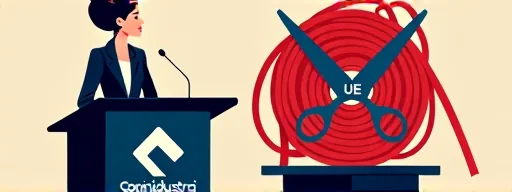
At a pivotal gathering of Italian industrialists in Rome, Prime Minister Giorgia Meloni launched one of her most pointed attacks on the European Union to date, branding Brussels a “bureaucratic giant” that is “myopic when it must make its voice heard” on the global stage. Addressing the annual assembly of Confindustria at the La Nuvola congress centre, flanked by President Sergio Mattarella, she urged the bloc to “do less and do it better,” invoking the principle of subsidiarity to roll back regulatory overreach. The speech, timed a day after local elections her centre-right coalition claimed as a recovery, sought to frame Europe not as a partner but as a constraint that “sacrifices growth on the altar of ideological and technocratic approaches.”\n\nViewed from Rome, the broadside was as much about domestic positioning as about Brussels. Italy’s economy remains sluggish: industrial production has contracted for over three years, purchasing power has crumbled, and nearly six million citizens live in absolute poverty, opposition figures note. Yet the immediate trigger is the energy shock rippling through European industry after the de facto closure of the Strait of Hormuz, which has sent prices soaring. Meloni has written to European Commission President Ursula von der Leyen requesting a temporary derogation from the Stability Pact to shield firms and households. Tommaso Foti, Italy’s minister for European affairs, conceded that “margins are tight” ahead of a possible answer on 3 June, but insisted the request was a distinct and urgent response to a supply-driven emergency, not ordinary fiscal slippage.\n\nThe appeal for leniency, however, lands awkwardly in northern European capitals and on trading floors. As the Neue Zürcher Zeitung notes, Meloni was until recently lauded as a guardian of budget discipline; rating agencies upgraded Italy’s creditworthiness for the first time in twenty-three years at the end of 2025, and risk premiums fell. Now, with a general election on the horizon, the prime minister appears tempted to fill state coffers for campaign season, abandoning the stability narrative that had won favour in Frankfurt and beyond. Economists warn that Italy’s debt-to-GDP ratio, already projected to surpass Greece’s by 2027, leaves no margin for miscalculation.\n\nThe Confindustria speech has drawn predictable fire from the centre-left opposition, with former minister Pier Luigi Bersani calling it “her usual way of saving herself in corner and not recognising the problems,” and Democratic Party leader Elly Schlein noting that Meloni has been in office, with a comfortable majority, for nearly four years. As Brussels prepares its spring economic package, the clash encapsulates a deeper tension: Rome demands more autonomy to stimulate industry, while Berlin, The Hague and other capitals see a familiar Italian pattern of seeking exceptions when reform becomes uncomfortable. Whether the Commission grants a Stability Pact reprieve on 3 June will test whether Meloni’s rhetorical offensive can translate into tangible concessions, or whether it merely signals that the guardian of budget discipline has truly become a figure of the past.
This story appeared in
9 sources · 3 languages · 24h window