From Textile Bins to Lecture Halls: How Nations Are Rethinking the Value of Castoffs
A UAE textile recycling drive, Argentinian upcycling hacks and an Indonesian corporate programme show how states and citizens are discovering new worth in discarded clothes, paper and overlooked talent.
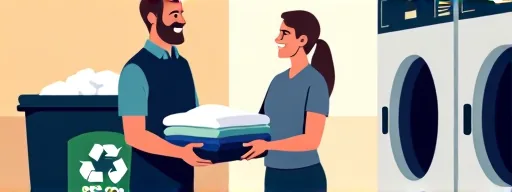
Abu Dhabi’s announcement of a national textile recycling initiative, Nasīj, marks one of the most ambitious state-led circular economy drives in the Gulf. Backed by a directive from Sheikh Mohamed bin Zayed Al Nahyan, the programme launches this weekend at Yas Mall, aiming to divert tonnes of discarded fabrics from landfills through a unified national platform. It arrives alongside a broader government push to embed measurable social impact into corporate culture, as evidenced by the Majrā campaign — a national CSR drive that promotes ESG standards and an “impact economy” — signalling that for the UAE, sustainability is fast becoming an operational metric, not a slogan.\n\nViewed from Jakarta and Singapore, parallel dynamics are emerging with distinct regional accents. Indonesian state-owned enterprise PNM has unveiled its RE3 For-E programme — Reduce, Re-love, Restyle for Environment, Economy, Empowerment, and Education — that channels employees’ unused clothing to small laundry entrepreneurs, creating a closed-loop system that serves both social and environmental ends. Meanwhile, Singapore’s NUS Business School is repurposing a different kind of underutilised asset: experienced professionals without formal degrees. Its new Executive Master of Science in Management opens a pathway for lifelong learners sidelined by conventional academic gatekeeping, reflecting an understanding that human capital, like textiles, can be revalued through intelligent redesign.\n\nAcross the Pacific, a more improvised ethos prevails. In Argentina, household ingenuity is turning old cotton t-shirts into reusable shopping bags — a low-tech, high-impact response to plastic waste — and repurposing defunct appliance manuals into aesthetic home organisers. Such frugal innovation, broadcast by local media, underscores a grassroots commitment to circularity that needs no top-down mandate, yet chimes with global ambitions to extend product life cycles. These practices, though small in scale, embody the same principle animating the UAE’s textile depots: that discards, whether fabric or paper, harbour latent utility.\n\nThe convergence of these stories — state mega-projects, corporate-community tie-ups, educational reform, and kitchen-table upcycling — points to a broadening definition of waste and value. Analysts in London note that the UAE’s attempt to yoke CSR to verifiable impact may offer a template for other rentier states seeking to diversify their economies. Yet the Argentine experience suggests durable change also rests on cultural shifts at the household level. The challenge, as these experiments proliferate, will be to scale circular models without extinguishing the local creativity that gives them life.
How the same story is told elsewhere.
The program turns discarded clothing into an engine for micro-entrepreneurs and laundry operators, creating a chain of environmental, economic, and educational benefits. Its core message is that what is no longer used can fuel a lasting, collective impact, linking ecological responsibility with community empowerment.
The Emirates unveil a corporate social responsibility drive and a unified national textile recycling platform, casting sustainability as a strategic cornerstone of the impact economy. Under visionary leadership, reuse is redesigned as a long-range circular framework that redefines the link between economic expansion and resource stewardship.
Old t-shirts and appliance manuals aren’t trash but household treasures: with scissors and a marker they become reusable shopping bags and clever organizers. The story promotes a domestic economy of small gestures, where saving money and cutting waste is within everyone’s reach, no grand programme required.
This story appeared in
4 sources · 3 languages · 24h window