Europe Braces for ‘China Shock 2.0’ as Trade Deficit Soars
European leaders sound alarm over China’s export onslaught threatening industrial heartlands, as Beijing defends state-led policies as no different from past Western strategies.
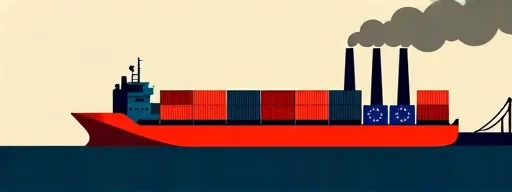
Europe’s industrial foundations are shuddering under what policymakers increasingly call “China Shock 2.0”. The trade numbers are stark: last year, Chinese exports to the European Union reached $651bn, while imports from the bloc totalled just $233bn. The dependence has deepened to uncomfortable levels — the continent relies on China for 90 per cent of its critical industrial and technological components, and a staggering 98 per cent of its solar panel imports. Viewed from Paris, Rome or Madrid, this is no longer competition but an economic invasion that demands an urgent defensive response.
Nowhere is the alarm more acute than in the automotive sector, the historic engine of European manufacturing. In a twist emblematic of the broader imbalance, several European carmakers, struggling with overcapacity and a slower-than-expected shift to electric vehicles, are handing over factories to Chinese rivals. The arrangement buys short-term utilisation but risks, in the words of Swiss analysts, a gradual “technological hollowing out” as Beijing gains know-how and footholds inside the single market. It is a high-stakes pact that illuminates the asymmetry: European firms chase capacity use while Chinese state-backed groups pursue a global expansion orchestrated by industrial policy.
That policy, originally framed as “Made in China 2025”, has morphed into what analysts in Sydney describe as an “industrial policy of everything” — spanning cars, machinery, chemicals, pharmaceuticals, artificial intelligence and software. The Rhodium Group argues that the Chinese Communist Party is doubling down on systemic over-investment and export-led growth that the rest of the world, and especially a semi-sluggish Europe, cannot absorb. The fear, voiced in capitals from Canberra to Brussels, is that China’s relentless push could obliterate large swathes of Europe’s industrial base within a decade, unravelling the political compact that underpins the EU itself.
Yet not everyone sees an existential threat. Analysts in Hong Kong and Beijing point out that state-led industrial strategy, subsidies and protection of infant industries are hardly a Chinese invention. Western Europe, the United States and the East Asian tigers all deployed such tools during their own catch-up phases. Cecilia Malmstrom, a former European commissioner, recently warned of an “ever more aggressive China”, but critics counter that the alarmism misses the mark: Beijing’s successful export machine is built as much on genuine competitiveness as on market-distorting support. Moreover, slamming the door on Chinese goods and investment could backfire by raising costs for European consumers and firms and by further fragmenting global trade.
For European leaders, the path forward is treacherous. The European Commission has launched anti-subsidy investigations into Chinese electric vehicles and is mulling defensive measures. But retaliation is almost certain, and many member states, reliant on Chinese demand for luxury goods and machinery, fear a tit-for-tat spiral. The coming months will test whether the EU can forge a united front — or whether the “China Shock 2.0” debate will itself become a source of internal division.
How the same story is told elsewhere.
China is waging an economic war on Europe, threatening to destroy its industrial base within a decade. The Chinese Communist Party's policies of massive over-investment and export dumping exploit Europe's weakened state and could shatter the European project itself. European leaders are finally waking up to this existential threat.
European fears over China's trade dominance ignore the fact that China's industrial policies mirror those historically used by the West and Asian tigers. Accusations of subsidies and technology theft are a distraction; Beijing's success stems from legitimate development strategies. Europe should look inward instead of scapegoating China.
Europe now finds itself without leverage, reduced from industrial leader to a battleground for economic invasion. Shocking trade figures—$651 billion in Chinese exports against $233 billion in imports—reveal a profound vulnerability, with the continent depending on China for 90 percent of key components. Calls for urgent action are growing, but Europe's industrial foundations appear deeply weakened.
China is settling permanently in Europe's backyard, becoming the first commercial partner of countries like Serbia while the EU hesitates. At the same time, European carmakers, seeking to fill idle production lines, are handing their factories over to Chinese rivals—a short-term fix that risks stripping the continent of key technologies. Europe must wake up to its own interests before it is too late.
This story appeared in
5 sources · 2 languages · 24h window