Brenner Blockades Cost Italy €500m as Alpine Tunnel Promise Remains Elusive
Mass protests shut the vital Brenner motorway as residents denounce pollution and Rome counts a half-billion-euro annual loss, while the world’s longest tunnel struggles to match the Gotthard’s unmet pledges.
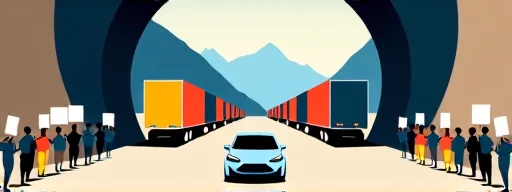
For several hours last weekend, one of Europe’s most critical north–south arteries was seized not by lorries but by thousands of protesters who marched, cycled and walked onto the Brenner autobahn, closing a section between Germany and Italy. Their chants – “Transit damages our health” – were led by local mayor Karl Mühlsteiger, who told the crowd that soaring lorry traffic had created an unbearable sanitary burden and must be cut. Families and veteran environmentalists mingled with local officials in the Alpine sun, but beneath the orderly demonstration simmered a sharper edge: on the same railway line meant to offer relief, a suspected arson attack disrupted services, raising the spectre of a longer and more volatile conflict.
Viewed from Vienna, the Tyrolean restrictions stem from an acute local crisis. Residents have endured decades of noise, dust and congestion as the Brenner corridor, Europe’s most-used transalpine freight route, funnels over two million trucks each year through narrow valleys. Successive Austrian state governments have imposed night-time and sectoral driving bans to ease the pressure, yet from Rome these are decried as de facto trade barriers. Uniontrasporti, an Italian logistics research body, now estimates the combined impact of Tyrolean traffic prohibitions and repair works on the Lueg Bridge at €544 million annually. Of that, €370 million flows directly from Austrian bans, while €174 million is attributed to bridgeworks that choke the motorway’s capacity. For Italian exporters, the figure is a mounting fiscal grievance that fuels the north–south political friction within the European Union.
Swiss Alpine communities watch with a weary sense of recognition. At the Gotthard pass, holiday queues routinely stretch for hours, and the country’s own freight shift from road to rail has advanced sluggishly, leaving the promised relief of its base tunnel largely unfulfilled. A new transit fee for foreign cars is now planned, as analysts in Zurich note that even the world’s longest railway tunnel – the 64‑kilometre Brenner Base Tunnel, which is mere metres from breakthrough – cannot guarantee that lorries will vanish from the surface. The Gotthard experience shows that ribbon-cutting ceremonies are one thing; genuinely decarbonising the Alps is quite another.
The Brenner protests, together with the suspected railway sabotage, signal a broader dissonance. As the European project demands seamless goods movement, the human and environmental cost on transit corridors has become impossible to ignore. With the base tunnel still years from completion and rail infrastructure lagging, the conflict is set to sharpen, reshaping not only Alpine logistics but the terms on which continental integration is sold to those who live in its shadows.
This story appeared in
6 sources · 2 languages · 24h window