Beijing’s Naval Show of Force: 100 Vessels Encircle Taiwan as New Frigate Joins Carrier Drills
China deploys its largest-ever flotilla around Taiwan, while the next-generation Type 054B frigate begins escorting the Liaoning carrier group, signalling a sharp escalation in maritime pressure.
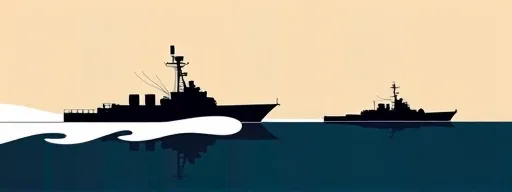
Within hours of Russian President Vladimir Putin’s departure from Beijing and days after a summit with Donald Trump, the People’s Liberation Army Navy and coast guard surged more than 100 vessels into the waters encircling Taiwan, from the Yellow Sea to the South China Sea. The scale of the manoeuvre, the largest on record, was unmistakably calibrated to send a message to Washington and its allies about Beijing’s resolve to dominate its near seas. The timing, just as high-level diplomatic engagements with Moscow and the White House concluded, underscored a dual strategy of dialogue paired with raw coercive display.
Far to the south-east, the Liaoning carrier battle group was conducting live-fire drills in the Philippine Sea, its escort screen including the newly commissioned Type 054B frigate Luohe. This was the vessel’s first operational deployment with a carrier formation, confirming the PLA Navy’s determination to integrate its most advanced surface combatants into blue-water missions. According to specialist defence media, the Luohe displaces around 5,000 tonnes, features a stealth-optimised hull and upgraded combat systems, and is primarily tasked with anti-submarine warfare—a critical gap as China’s carrier groups venture farther from shore-based air cover. Multiple hulls of the class are reportedly already under construction.
These parallel demonstrations of naval power coincide with a notable shift in foreign military activity in the Taiwan Strait. A report from a prominent Chinese think tank, cited by the South China Morning Post, notes that while US transits through the strait have been scaled back and kept deliberately low-profile, passages by Five Eyes allies and other non-regional navies have risen sharply since 2024. The institute’s director, Hu Bo, assessed that such transits do not pose a direct military threat but are increasingly politicised, raising tensions. Viewed from Beijing, the allied activity is a collective pressure campaign; from Washington, the US drawdown reflects a calculation to avoid inadvertent escalation while encouraging partners to share the burden of asserting navigational rights.
Taken together, the episodes paint a picture of a rapidly maturing Chinese fleet that is learning to combine overwhelming numbers with technical sophistication. The debut of the Luohe alongside the mass encirclement of Taiwan is not merely a show of vanity but a rehearsal for potential contingencies, forcing Tokyo, Taipei and allied capitals to gauge the thresholds of Chinese tolerance. For now, the message is unambiguous: while Beijing is happy to talk summits, it will not hesitate to rewrite the maritime norms of the Western Pacific on its own terms. The coming months will test whether the US-led alliance system can absorb such assertive choreography without stumbling into a cycle of miscalculation.
This story appeared in
3 sources · 3 languages · 24h window