Ancient Art and Laser Scans Reveal Lost Civilisations Across Three Continents
A Byzantine city uncovered through an ancient mosaic map and other finds from Welsh caves to Egyptian pyramids reveal how past and present are converging.
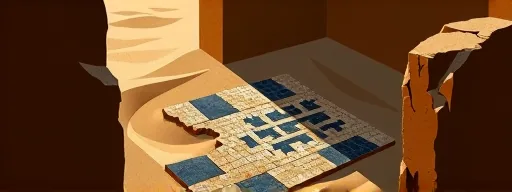
In a striking confluence of ancient artistry and 21st-century technology, archaeologists have unearthed a long-lost Byzantine settlement in the Jordanian desert, using a 1,500-year-old mosaic map as their guide. The map, embedded in the floor of St George’s Church in Madaba, had long tantalised scholars with its depiction of a vanished city; but it was only when an international team overlaid its details with airborne laser scanning (lidar) that the buried streets and structures of this once-thriving community emerged from the sands. The discovery underscores how heritage from the distant past can inform cutting-edge science, turning myth into measurable reality.
The resonance between ancient representation and modern revelation extends far beyond the Middle East. In South Wales, a panel of red stripes inside Bacon Hole cave, first noted in 1912 and long dismissed as natural mineral seepage, has been re-examined and declared the oldest known prehistoric art in Britain and north-western Europe. Created by human fingers some 17,100 years ago, the markings date to the Upper Palaeolithic, forcing a reconsideration of early human symbolic behaviour in the region. Viewed from London, the finding elevates a humble cave near Mumbles into a site of global significance, rewriting the island’s deep cultural chronology.
Across the Mediterranean, the puzzle of Egypt’s pyramids continues to provoke unconventional thinking. A French-led team writing in PLOS ONE has proposed that the Step Pyramid of Djoser at Saqqara may have been built using an advanced hydraulic system, a network of water channels and floats designed to lift colossal stone blocks. The hypothesis, while controversial, reflects a broader shift in archaeology away from purely labour-intensive explanations and towards the recognition of sophisticated pre-modern engineering. From Parisian laboratories to the Giza Plateau, the debate highlights how enduring riddles still have the power to attract innovative scientific attention.
Such academic speculation unfolds against a backdrop of urgent economic imperatives. Cairo has announced the discovery of a trove of artefacts – a marble head of Aphrodite, pharaonic funerary furniture, and the remains of a Roman basilica – in Beni Suef, explicitly framing them as levers to revive a tourism sector battered by political turmoil and pandemic. The finds, coinciding with the long-awaited inauguration of the Grand Egyptian Museum, illustrate how archaeology in the region is increasingly harnessed for national rebranding and foreign-currency generation.
Taken together, these developments reveal a global archaeology at a crossroads. In the Levant, researchers are decoding ancient maps to locate lost cities; in Europe, they are rehabilitating overlooked cave art; in North Africa, they are testing bold engineering theories while feeding a hunger for heritage-driven growth. Analysts in Amman, London, and Cairo alike note that the past is being pressed into service for the present – whether as a guide for lidar, a mirror for cultural identity, or a magnet for tourist dollars. As technology demystifies old enigmas, it also creates new imperatives: to preserve what is revealed and to question whose story is being told.
How the same story is told elsewhere.
A lost Byzantine city has been brought back from oblivion by uniting a 1,500-year-old mosaic map with cutting-edge laser scans. The breakthrough reveals how the engineering wisdom of the ancients still speaks to modern science. History is being rewritten not by chance but by the deliberate fusion of past and present knowledge.
Red ochre stripes in a Welsh cave, dismissed for a century as a natural stain, have been scientifically dated to 17,100 years ago and are now recognized as Britain’s oldest prehistoric art. A research team re-examined the marks and overturned the earlier misidentification. The case demonstrates how modern analytical methods can correct long-standing archaeological errors.
A revolutionary study claims that Egypt’s pyramids were not built by human muscle but with an advanced non-human technology that the establishment has kept hidden. The finding destroys the official history and reveals a centuries-old secret finally brought to light. Those who controlled the narrative are accused of a massive cover-up.
This story appeared in
4 sources · 3 languages · 24h window